Wednesday, 15 November 2017

Friday, 10 November 2017
Remembering the dead - in action, in prayer, as community

The text and the pictures of this post are taken from Religion News Service
This is from a USA viewpoint - but The Editor of this blog thinks it applies in
other nations and situations as well.
This is from a USA viewpoint - but The Editor of this blog thinks it applies in
other nations and situations as well.
Who decides when we as a country pray
and when we act?
and when we act?
By Chloe Breyer
(RNS) — The similarities and contrasts of two terrible attacks in recent days — one in Manhattan and one in Sutherland Springs, Texas — begs the question: When do we as Americans pray, and when do we act?
In one case, after a man driving a truck ran over scores in New York City, our president demanded new immigration restrictions immediately without qualms about offending the friends and family of victims, who came from Argentina, Belgium, New Jersey and New York.
And after a gunman attacked a Texas church five days later, President Trump called for prayers and skirted any discussion of policy change. Conservative lawmakers argued that discussing gun control would be an offense to the 25 people between the ages of 1 and 77 who, like the innocent civilians in New York, were also killed in cold blood.

As an Episcopal priest and director of the Interfaith Center of New York, I believe the dichotomy between prayers and action portrayed in the Twitter feeds of our leaders is a false one and serves neither the dead, the bereaved, nor our nation as a whole. It reveals a narrow view of prayer on the one hand and a shortsighted understanding of action on the other.
Last Tuesday evening (Oct.31), after establishing that friends weren’t in the path of the attacker’s van, I saw an email from a member of the Majlis Ashura (Islamic Council of New York), a fellow member of New Yorker Interfaith Coalition Against Islamophobia. The email read, “I hope and pray someone will be organizing an interfaith vigil.”
Along with the Muslim Community Network and other faith groups, we began a now all-too-familiar drill: Find a location, secure a permit, put up a Facebook invite, get co-sponsors, rent sound equipment, locate electric candles, draw up a speakers list and send out invitations. By early Wednesday morning, a plan was in place.
Who arrives at a moment’s notice to something like this? Who showed up at this vigil on Wednesday night on the steps of Foley Square to commemorate the dead and to pray for the city? Debbie Almontaser, a co-organizer of the vigil and the chair of Muslim Community Network, welcomed the assembled crowd and introduced Manhattan’s borough president. Then came an inspiring slate of diverse religious leaders from all over the city.
We heard from a member of Sadhana: The Coalition of Progressive Hindus, a bicyclist herself who brought her bike up on our makeshift stage as she said her Hindu prayer. Rabbi Sharon Kleinbaum of Congregation Beit Simchat Torah and Evan Bernstein of the Anti-Defamation League offered their Jewish perspective. Three prominent Christian pastors spoke as well: the Rev. Winnie Varghese from Trinity Church Wall Street, the Rev. Jacqueline Lewis from Middle Collegiate Church and the Rev. Kaji Dousa from Park Avenue Christian Church.
Aldo Rafael Perez of the Islamic Leadership Council of New York — in Spanish and English — mourned the dead, prayed for the families, condemned terrorism and gave thanks for the police and first responders who put their lives on the line to stop the carnage.
Family and friends of Nicholas Cleves introduced themselves to us at the vigil. Nicholas was the 23-year-old software developer, Skidmore College graduate and only native New Yorker of the eight people murdered last Tuesday. Bahij Chancey, Nicholas’ childhood friend, carried a piece of cardboard with his name on it and photographs of Nicholas smiling astride his bike. The religious leaders and Nicholas’ family and friends read the names of the dead one at a time, by the light of the plastic candles we all held up.
This understanding of prayer — a collective, public expression of grief and solidarity inclusive of Islam, the very religious tradition so desecrated after the suspect, Sayfullo Saipov, reportedly said he committed his atrocities in its name — this vision of prayer that recognizes our common humanity across faith lines and national borders, seems wider than the definition of prayer many of our political leaders express after American mass slaughters.
A narrow understanding of both prayer and action was on display from the White House in the recent inconsistent response to the two terrible tragedies.
According to our national leadership, prayer actually has a narrow and specific meaning: It is something that Christian Americans do when they lose their loved ones to indiscriminate violence. Other prayers, such as those expressed in New York, with the outpouring of grief from Buddhist, Hindu, Jewish and Muslim religious leaders, are deemed less valid.
How else do we explain that in the Sutherland Springs church shooting, the administration deems discussion of policy change as an affront to the prayers of the bereaved? But in the case of New York, the prayers of bereaved families and fellow citizens should apparently not be offended by a same-day call to end the green card lottery.
The prayers and heartache of some were less valid than others and therefore not worth the sign of “respect” that a pause in policy advocacy apparently indicates.
And what about action? The juxtaposing of the New York City and Sutherland Springs attacks again reveals a shortsighted and narrow definition of the word in the mouths of our national elected leaders. The action we need at this time – across both acts of mass violence – is coming together across our diverse backgrounds to find solutions rooted in evidence, not religious discrimination.
We need inclusive prayer and farsighted action together.

Martin Luther King Jr., second from left, and Abraham Joshua Heschel, second from right, during Selma march in 1965. Courtesy of Susannah Heschel
Rabbi Abraham Joshua Heschel, the civil rights leader and scholar who marched with the Rev. Martin Luther King Jr., when challenged by some people in his community as to why he would march on the Sabbath, replied famously that he was praying with his feet. Heschel, like King, embraced the prophetic strand of his religious tradition as much as he did the pastoral. He knew his civil rights activism for policy change was sacred because Jim Crow laws and legally justified segregation denied the God-given equality of all people regardless of race, religion, gender or national origin.
With the benefit of hindsight, we know King and Heschel’s “actions” to be prophetic. At the time, plenty of their pro-segregationist enemies would have been quick to call their activism disrespectful for whatever reason happened to be lying around at the time.
Policy or action, then, when it is portrayed by politicians as “disrespectful” to the prayers and grief of those who mourn the death of their loved ones in the recent senseless killings in New York and Southerland Springs, deserves a qualifier when it is pronounced as such by our political leaders. What they really mean is “certain policy actions” are disrespectful to “a particular kind of expression of prayer.”
(The Rev. Chloe Breyer is executive director of the Interfaith Center of New York and an associate priest at St. Philip’s Episcopal Church in Harlem. The views expressed in this opinion piece do not necessarily reflect those of Religion News Service.
Thursday, 9 November 2017
Religious freedom for Indonesian native faiths
Court recognises Indonesian native faiths in victory for religious freedom

Dewi Kanti adheres to a traditional Indonesian religious belief system known as Sunda Wiwitan, which venerates the power of nature and the spirit of ancestors.
She is among perhaps 15 million native-faith followers in Indonesia who have been discriminated against for decades by Indonesia's policy of only recognising six official religions.
As it stands, Indonesians have had to list their religion as Muslim, Catholic, Protestant, Hindu, Buddhist or Confucian on their national identification cards –or leave the religion field blank.
But those who left their ID cards blank had difficulty registering their marriage, obtaining birth certificates, accessing employment as civil servants and applying for government services.
Now, in an historic victory for religious freedom in Indonesia, the Constitutional Court ruled on Tuesday it was discriminatory to require native-faith followers to leave the religion field blank.
Constitutional Court Judge Saldi Isra said this was not in line with the spirit of the 1945 Constitution, which enshrines religious freedom.
The court recommended that a seventh category be created – native-faith followers – although the card would not specify the particular faith.
Sunda Wiwitan is one of several hundred native-faith beliefs across Indonesia. They follow an animistic system of belief but over time have been influenced by other religions including Hinduism and Islam.
Ms Dewi welcomed the Constitutional Court decision. "Our fight has borne fruit," she said.
"The most important thing is the restoration of civil rights especially for those who have been stigmatised. Under the repressive New Order regime, I was stigmatised as (following) a deviant sect. This is a realisation on the part of policymakers that there has been an abuse of our constitutional rights."
Despite practising a native Javanese faith, Ms Dewi's husband had been forced to put "Catholic" on his ID card so the couple could obtain birth certificates for their children.
She said it was almost impossible to know how many people still adhered to Sunda Wiwitan, because there were no administrative records.
"In 1964 there were around 10,000 to 15,000 of us," she said.
However, blasphemy laws passed in 1965 stipulated only six religions would be officially recognised.
"The New Order regime said it was compulsory for all citizens to follow a religion, this was a policy to fight communism because communism was regarded as atheist or not believing in God," said Bonar Tigor Naipospos, the vice chairperson of the Setara Institute for democracy and peace.
"Native faith was regarded as not believing in God because it was ethnocentric."
He said the Constitutional Court ruling provided protection to followers of native faiths and granted equality among followers of other religions.
Human Rights Watch Indonesia researcher Andreas Harsono said the court ruling marked the end of Indonesia only recognising six religions.
Saturday, 28 October 2017
Shabbat Shalom

From the Facebook site of
We pray for a refreshing Shabbat for all our Fellowship friends around the world!
Have our daily devotionals sent straight to you:bit.ly/2gG8Qlo
Monday, 16 October 2017


Thursday, 12 October 2017
Victoria's Voluntary Assisted Dying Bill - Religions protest

Pressure is mounting on state MPs as they prepare to debate controversial voluntary euthanasia laws next week.
The pro and anti campaigns are ramping up their efforts, with voting on the bill to begin as early as next Thursday.
More than 120 doctors from around the state intervened on Wednesday, writing to all 127 parliamentarians, urging the politicians to "reduce the suffering" of terminally ill Victorians by voting in support of the euthanasia laws.
The doctors' intervention came as a coalition of religious leaders launched a united campaign on Wednesday, pushing for a no-vote.
Muslims, Buddhists, Hindus, Jews, Sikhs and Christians gathered on the steps of Victorian Parliament to deliver a statement opposing the laws to Deputy Premier James Merlino.
The material for this post has been taken from Ballarat's daily newspaper, The Courier.
For more information on what is being considered/proposed by the Victorian Govt,
please read
Editor's Note:
With Voluntary Assisted Dying, people are being offered an option.
There are particular safeguards on the manner of carrying out the option.
Those with conscientious objections have their objections respected.
The role of palliative care is neither overlooked nor is it excluded.
Wednesday, 4 October 2017
Conservatism and Conversion within a Gun Culture
The overtly religious America we so often see depicted and reflected politically in contradiction to the Christian scriptures, often seems to those outside the USA to be hypocritical in a confronting and conflicting way.
Two years ago I wrote a post about my friend who went to a church service in Mississippi and heard the Pastor stand up and talk about a competition they were running to see who could invite the most new people along to the church in one month.
And what was the prize for the winner? An AR-15 assault rifle – plus a 100 rounds of ammo for good measure. My friend could not believe it as he watched the Pastor hold the gun up and enthusiastically announce ‘This is a killing machine’:
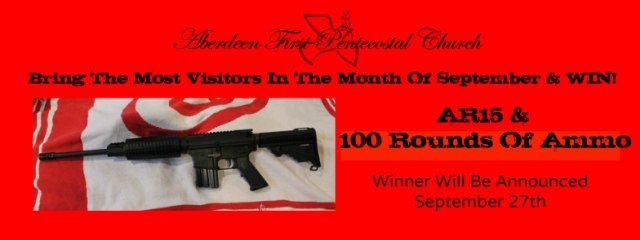
There was a good ending to the story because my friend’s concerns led to a genuine dialogue which resulted in the church graciously withdrawing the prize. Instead, my friend, who is a carpenter, offered to donate a coffee table he had made which was awarded instead of the gun. He was inspired by the passages in Isaiah about ‘beating swords into ploughshares’ (2:4) and rather than just condemning the church wanted to help find a more creative and redemptive way forward.
The terrible events of Las Vegas this week will see predictable re-runs of the arguments between proponents and opponents of gun control. We will also see plenty of hashtags and trite appeals to #prayforlasvegas. I believe God is wearied by these prayers, especially from people who are so opposed to taking any steps which will produce real change.
Many people are saying that after Sandy Hook, where 20 children were killed by a gunman, that there is no longer any hope for meaningful gun reform. Perhaps they are right.
A mass movement for change?
But could we dream about what would happen if gun-owning Christians, led and inspired by church leaders, decided to make the first step and decided to lay down their guns as part of a mass movement and hand them in? It could be a ‘Gun Jubilee’ inspired by the cancellation of debts instructed in Deuteronomy 15.
It may sound naive but I think history tells us the only hope for radical change lies in some form of coordinated, faith-inspired, mass movement. Faith may be easily misdirected or corrupted but it is also the only force which can provide the sufficient bandwidth of public vision and spiritual energy to create change. At its best, authentic Christianity is personal, practical, public and political.
On December 1st 1955, Rosa Parks refused to move from her seat on the bus and sparked a critical phase in the civil rights movement. Who will be prepared to make a costly stand on this issue?

Celebrating the birth of Bahaúllah
This song celebrates the 200 years since the birth of Baha'u'llah.
The sunrises and sunsets in this video represent that passage of time.
Khadijih was the name of His mother as Mary was the mother of Jesus!
Hope you like it and now available in itunes!
Subscribe to:
Posts (Atom)