Showing posts with label Africa. Show all posts
Showing posts with label Africa. Show all posts
Thursday, 17 May 2018
Sweet honey in the rock - Ella's Song
Back in 1985, I was one of a small number of women funded and sponsored by the Australian Government to attend the World Conference on Women in Nairobi, Kenya. It was/is a major event in my life. I hadn't heard of Sweet Honey in the Rock. However, one of our number knew about them and knew they were appearing in concert and where. I fell in love with them.
Some years later, I was living in Sydney and Sweet Honey was performing there and I was able to see and hear them once again. The technological wonders of this modern age mean that I can continue to keep up with them .... if you can call "keeping up" getting past my old favourites. I hope you can enjoy them too --- and keep on coming back.

Friday, 21 July 2017
INTERFAITH DIALOGUE A CUTTING-EDGE NECESSITY IN AFRICA

Story from Ngala Killian Chimtom
July 20, 2017
Picture at left: Bishop Jean-Marie Benoit Bala of Bafia, Cameroon. (Credit: Valérie leon (Travail personnel) [CC BY-SA 4.0], via Wikimedia Commons.)
Participants at a meeting of central African bishops this week recommended inter-religious dialogue as the way forward for the sub-region. They also reiterated claims that the death of Cameroonian Bishop Jean-Marie Benoît Balla was not a suicide, but that he was "brutally assassinated.”
YAOUNDÉ, Cameroon - Inter-religious wars in the Central African Republic, the excesses of the terrorist sect Boko Haram in Cameroon, and a steep rise in Christian revivalist movements are rapidly changing the religious landscape in the Central African sub-region, and paving the way for religious intolerance.
In the Central African Republic, the fight for political control became increasingly religious with the Muslim Seleka rebels wresting control of the capital Bangui in 2013 and looting, raping and killing the Christian-dominated Anti-Balaka. But when the Christians seized back the capital months later, they committed the same crimes against the Muslims.
In Cameroon and Chad, the Nigerian Islamist sect Boko Haram has become a source of continued attacks, killing at least 500 civilians since it started cross-border attacks in 2013. Across the entire area, a rise in Pentecostal movements and their extremist ideologies has taken sway. “The Central African sub-region is in crisis, and these crises are an expression of hate,” says the 86-year-old Archbishop emeritus of Douala in Cameroon, Cardinal Christian Tumi. “If I love my brother, if I love my sister, I won’t take up a gun to kill him,” he added.
In view of the troubling situation, some 80 Catholic bishops from the Central African Sub-region along with representatives from other Christian denominations and Muslim communities came together in Yaoundé for the 11th Forum of the Episcopal Conferences of Central Africa, with ecumenism and inter-religious dialogue at the centre of their discussions.
The bishops and their guests discussed “Islam in Central Africa today,” traditional African religions and inter-religious dialogue,” “Christianity, Islam and Politics,” as well as “dialogue between the Catholic Church and the different Islamic currents in Central Africa.”
READ THE ENTIRE STORY
AT CRUX MAGAZINE
Sunday, 9 July 2017
Witchcraft in literature and life
The author of this blog has, as her oldest internet friend - even before blogs, Steve Hayes who lives in South Africa. Steve's blog is Khanya. The post below was published on his blog on 7 July 2017. It is republished here with Steve's permission for which I am grateful. For some people, this might be an unusual or distasteful topic. However, without serious consideration and knowledge of this topic, we will be hindered in understanding a large slice of humanity. In fact, when the author of this blog was doing her degree in religious studies, we started off with the James Frazer's The Golden Bough. The Ballarat Library holds the complete set of The Golden Bough - and it is not tucked away in storage but right there on the shelves. ~~~~~~
Witchcraft in literature and life (coffee klatsch)
7 JULY 2017
At our literary coffee klatsch this morning we discussed witchcraft in literature and life, but we didn’t nearly exhaust the subject, so we decided to to continue the discussion next time.
The reason for discussing it was that Duncan Reyburn had published a contribution in a book on witchcraft and demonology, but the book cost far more than most of us could afford, so we asked him to tell us a bit about it and his approach to the subject. I was also struck by the difference between his bibliography and mine in an article on witchcraft 20 years earlier. I dealt with all this in an earlier article, so I won’t repeat it here.
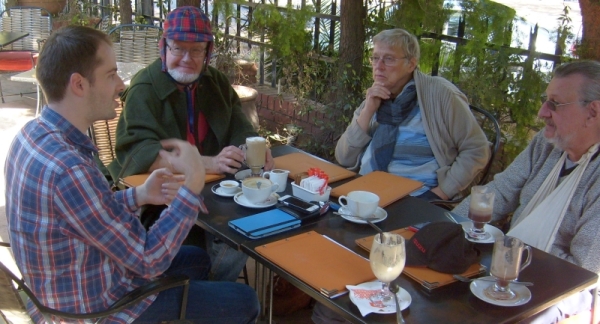
NeoInklings Literary Coffee Klatsch: Duncan Reyburn, David Levey, Janneke Weidema, Tony McGregor.
Cafe 41, Arcadia, Tshwane
Cafe 41, Arcadia, Tshwane
Duncan’s contribution to the books was about how King James was a being really nasty when he wrote his book Daemonologie in 1597. He interprets it in the light the work of René Girard (1923-2015) and especially Girard’s concept of mimetic desire.
If people imitate each other’s desires, they may wind up desiring the very same things; and if they desire the same things, they may easily become rivals, as they reach for the same objects. Girard usually distinguishes ‘imitation’ from ‘mimesis’. The former is usually understood as the positive aspect of reproducing someone else’s behavior, whereas the latter usually implies the negative aspect of rivalry. It should also be mentioned that because the former usually is understood to refer to mimicry, Girard proposes the latter term to refer to the deeper, instinctive response that humans have to each other.
Duncan said that just as King James believed that witches wanted him dead, so he wanted them dead, and vice versa. King James recommended the persecution of witches because he believed that witches were conspiring against him. King James also did not have any clear conception of demons. He believed that witches were inspired by Satan, and there was no hierarchy (or “lowerarchy”, as C.S. Lewis calls it) of evil. There was just Satan and the witches, with no demons in between.
Janneke said that this recalled the Calvinism of her youth, which flattened the hierarchy of the church, so that there were just elders and people. She said this was correlated with literacy — as more people learned to read, they became less reliant on a clerical class.
I recalled reading a book by John Buchan (an imperialist and member of Milner’s Kindergarten) called Witch Wood. I read it a long time ago, and have not seen a copy since, but as I recall it, the good Calvinists went to church by day and practised witchcraft by night, but saw no conflict, because they were among the elect, predestined to be saved, so nothing they did could affect that. I suspect that Buchan’s understanding of the matter was about as accurate as his picture of African Independent Churches in another novel, Prester John, which was, however, probably accurate in the picture it gives of the views of such churches by British civil servants in the conquered Transvaal Colony.
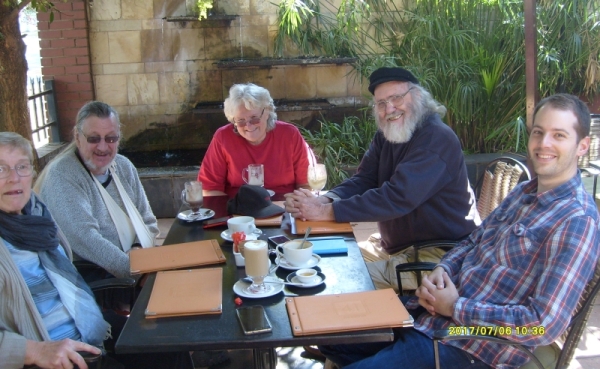
Janneke Weidema, Tony McGregor, Val Hayes, Steve Hayes, Duncan Reyburn — literary coffee klatsch, 6 July 2017
King James wrote his Daemonologie in 1597, at the height of the Great European Witchhunt. People whose minds are saturated with modernity like to refer to those witchhunts as “medieval”, but they were not, they were modern, and arose in the Early Modern period. It is interesting that in the current period, when much of Africa is in transition from premodernity to modernity, there has also been an increase in witchhunting.
Charles Williams, one of the original Inklings, wrote Witchcraft, a history of Christian responses to witchcraft, and noted how the attitude to witchcraft completely changed in the early modern period. Previously it was considered heretical for Christians to believe that witches could harm people, because it showed a lack of faith in Christ, who had conquered evil. In Early Modern Europe, however, it became heretical not to believe that witches could harm people. Earlier, people who made false accusations of witchcraft could be punished, but in Early Modern Europe failure to accuse could be interpreted as a sign of being a witch. Witchcraft came to be seen as a huge satanic conspiracy against church and state. As Charles Williams puts it:
The Salic law of Charlemagne decreed that anyone who was convicted of witch-cannibalism should be heavily fined, but also that anyone who was found guilty of bringing such an accusation falsely should be fined an amount equal to one third of the other… The secular governments of centuries earlier had been wiser; they had penalized the talk as much as the act. The new effort did not do so; it encouraged the talk against the act.
Christianity came into a world in which witchcraft was already known and feared as evil. For many pagans, the only proper penalty for witchcraft was death. Again, as Charles Williams put it:
Before Christendom began, magic, with its lower accompaniment of witchcraft, preoccupied the whole Roman Empire; we have forgotten the darkness out of which we came. It was as popular as it was perilous. It was certainly regarded by the authorities as a public danger, but, on the whole, action against it was taken only by private persons in lawsuits or by the government in suspicion of treason.
In much of premodern Africa, witches were regarded as incorrigible, and the only way of nullifying their power was to kill them. Nearly all evil, sickness, accidents and other misfortunes, were regarded as being caused by human malice — witchcraft. There were spiritual or religious specialists who could smell out who was responsible for a particular misfortune, and the English translated most of the words for these specialists as “witchdoctors” — doctors who could remedy the evils caused by witchcraft.
Christian missionaries from late modern Europe and North America could not cope with premodern notions of witchcraft, and so saw their mission as modernising Africans (they called it “civilising”) to show them that such notions were false and out of date. It was African independent church groups like the Zionists who recontextualised the Christian gospel back into premodern terms to show how it could deal with African problems rather than modern European ones.
We briefly discussed the way in which, in English usage, “witch” has come to be seen as mostly female, while the male equivalent are called “wizards”, as in the Harry Potter stories. Perhaps we can talk about that more next month. Some did a bit of Googling on cell phones, but I think the following is more helpful:
What really is a witch? One answer lies in the roots and development of words. ‘Witch’ derives from the Old English wicca (pronounced ‘witcha’ and meaning male witch) and wicce (‘female witch’, pronounced ‘witcheh’) and from the word wiccian, meaning ‘to cast a spell’. Contrary to common belief among modern witches, it is not Celtic in derivation, and it has nothing to do with the Old English witan, ‘to know’, or any other word relating to wisdom. The explanation that witchcraft means ‘craft of the wise’ is false…‘Wizard’, unlike ‘witch’, really does derive from Middle English wis, ‘wise’. The word first appears about 1440, meaning a ‘wise man or woman’; in the sixteenth and seventeenth centuries it designated a high magician, and only after 1825 was it used as the equivalent of ‘witch’ (Russell 1980:12).
For others who were there, if you think I missed something important, or got something wrong, please clarify in the comments section.
Till next time…
Monday, 16 June 2014
Religion and women after trauma and violence
Religion is two-edged sword for women after trauma and violence
 Left to right, Dr. Silka Spahic Siljak and Dr. Susan St. Ville
13 June 2014
Religion is a double-edged sword for women healing from violence and trauma, say two scholars whose work investigates and analyses the area.
Dr Susan St. Ville teaches in and directs the master’s programme at the Joan B. Krock Institute for International Peace Studies at the University of Notre Dame, U.S.A., while Dr Zilka Spahic Siljak, a Bosnian scholar, serves currently as a visiting lecturer in Women’s Studies and Islamic Studies at Harvard Divinity School.
The two theologians visited the Ecumenical Centre while facilitating the weeklong workshop on “Women’s Pilgrimage of Justice and Peace—Inspired by UNSR1325,” sponsored by the Ecumenical Institute Bossey, the educational engine of the World Council of Churches (WCC).
The seminar was developed by the WCC programme Just Community of Women and Men (formerly Women in Church and Society) led by Dr. Fulata Lusungu Moyo, programme executive, and focussed on making accessible UNSCR1325 to religious women.
UNSR1325 is the UN Security Council resolution that mandates focus on and involvement of women in post-conflict arrangements for peace-building and reconstruction, a key asset for developing or restoring gender justice in war-torn areas that have witnessed large-scale gender violence.
Religion: friend or foe of women?
While recent Gallup Polls, for example, still demonstrate the ongoing influence and authority of religion in people’s lives, says Siljak, it varies wildly in different contexts. In post-socialist regimes of Eastern Europe and during the Bosnian war, for example, religious institutions and church bodies proved not helpful to women. “Religion is not helpful if politicized or manipulated” as a tool of nationalism, she said. “But personal religion was helpful for women who had been victimized by violence as a means of coping with trauma and moving on to reconstruct their lives.” In the end, she said, their faith in God can help women heal.
Against a backdrop of institutional indifference, Siljak noted, women have created “alternative spaces” and faith-based organizations to address their concerns. Ironically, she said, the work of secular organizations can sometimes provide a platform for and impetus to religious women to organize.
Still, in many contexts “churches have been real resources for resilience,” said St. Ville, citing work in East Africa, particularly Uganda, where she has seen religious women create effective programmes for counselling and post-trauma life-support for women after 20 years of war.
Practice trumps and validates theory
Although at the forefront of recognizing and engaging diversity and the role of practice, feminist theory and theology still struggle for legitimacy in academic settings and are often seen as too abstract, both scholars affirmed.
“The WCC functions well as a partner in this dialogue” between theory and practice, said Siljak, since it provides access to a global infrastructure of women active in religious settings around the world, both individually and in powerful movements on the ground. “Women’s movements are feminist theory in practice,” said St. Ville, and theologians can “use the great religious infrastructure” to inform their theologies and support real change. To stay relevant, she said, theologians “should not allow theories to discount practice.”
Frontiers of feminist reflection
After a generation of pioneering feminist theology and historical work, and of feminist theory, where is the feminist engagement with religion headed?
Siljak finds inspiration in on-the-ground women’s movements, especially in Roman Catholic communities of women religious and in Islamic communities. There she witnesses women working with, through, and around religious traditions to find affirmation, respect, and authority. In nonreligious NGOs, too, Siljak experiences helpful inter-religious encounters of Christian, Muslim and Jewish women.
For St. Ville, the feminist quest still centres around the question, “How do women get agency?” whether in situations of violence and trauma, in creating movements for social change, or in the academic disciplines.
Although for post-trauma women “the theodicy question is huge,” she marvels at how, despite the checkered legacy of faith communities in relation to women, “People find their way through it in different ways, through their personal faith journeys.” Attending to how women actually cope as individuals and in movements, she says, is the privileged site of new learning, because “People find their way out of pain in amazing ways.”
The World Council of Churches promotes Christian unity in faith, witness and service for a just and peaceful world. An ecumenical fellowship of churches founded in 1948, by the end of 2013 the WCC had 345 member churches representing more than 500 million Christians from Protestant, Orthodox, Anglican and other traditions in over 140 countries. The WCC works cooperatively with the Roman Catholic Church. The WCC general secretary is the Rev. Dr Olav Fykse Tveit, from the [Lutheran] Church of Norway.
Visiting address: 150 route de Ferney, 1211 Geneva 2, Switzerland
Saturday, 7 December 2013
Quakers in Africa mourn the passing of Nelson Mandela
·
On the passing of Nelson Mandela,
Central and Southern Africa Yearly Meeting of the Religious Society of Friends’
issued the following statement:
We mourn the passing of our former President and leader, Nelson Mandela. Although Madiba was of a great age, his death marks the end of an era. The people of South Africa and the region are filled with love and sadness. We also express our condolences to his family and friends, in their grief. The Religious Society of Friends (Quakers) of Central and Southern Africa wish to express our deep sadness at Madiba’s passing. At the same time, our deep admiration, respect and gratitude for Mandela’s life and the legacy that he has left not only South Africa but also Africa and the world.
We mourn the passing of our former President and leader, Nelson Mandela. Although Madiba was of a great age, his death marks the end of an era. The people of South Africa and the region are filled with love and sadness. We also express our condolences to his family and friends, in their grief. The Religious Society of Friends (Quakers) of Central and Southern Africa wish to express our deep sadness at Madiba’s passing. At the same time, our deep admiration, respect and gratitude for Mandela’s life and the legacy that he has left not only South Africa but also Africa and the world.
“Freedom is in your hands” is a line from a well-known freedom song sung during the dark days of apartheid. Millions of South Africans stood up to the violence and brutality of the apartheid state and to the degradation of official racism. Nelson Mandela was our leader, and it did seem that freedom was in his hands. Mandela’s human and spiritual qualities lit the path to genuine liberation. He was steadfast in his refusal to accept a lesser status for black people, steadfast in his refusal to hate white people, steadfast in his determination to bring about freedom and equality – liberating all of us, black and white. He was a man of rare magnanimity – of ‘’great spirit’’, responding with forgiveness and reconciliation to provocation and suffering.
Nelson Mandela led with strength, grace, humour, and humility. He eschewed the riches that some take from high office. After stepping down as President, he focused his energies on developing and supporting the most vulnerable, the children of our nation.
This is a difficult time for South Africans. We will have to face our future without the calm, guiding presence of Mandela. We may feel uncertain, anxious, and even fearful. Mandela would not want this for us. He would want us to reach out to each other, to stand together to meet the challenges of our future.
We recommit ourselves to the central challenge of our time – to continue Mandela’s struggle for equality and freedom. The Religious Society of Friends has long recognised that social justice is the basis for peace among people. We view the massive inequalities in wealth, not only in South Africa but also Africa and the world, as a dangerous threat to peace and stability. Genuine freedom includes the freedom to develop our full potential as human beings. Extreme poverty does not allow this and so the wealth gap must be tackled to allow for genuine social development.
We honour Mandela’s vision of a country at peace with itself and recommit ourselves to realising this in our life time.
Hamba Kahle Nelson Mandela, our Madiba!
6 December 2013
Wednesday, 9 October 2013
Museum of Australian Democracy at Eureka - M.A.D.E. : Human Rights Arts and Film Festival - Oct, Nov 2013
| ||||||||||||||||||||||||||||
| ||||||||||||||||||||||||||||
|


Tuesday, 8 October 2013
Women of Islam - 5

Nana Asma'u (Nigeria,
1793-1864)
Nana was a
princess, poet and teacher. She was fluent in Arabic, Fulfulde, Hausa and
Tamacheq and well versed in Arabic, Greek and Latin classics. In 1830, she
formed a group of female teachers who journeyed throughout the region to
educate women in poor and rural regions. With the republication
of her works, that underscore women's education, she has become a rallying
point for African women. Today, in northern Nigeria, Islamic women's
organizations, schools and meeting halls are frequently named in her honor.
(Photo:
Fula women.)
Friday, 20 September 2013
Subscribe to:
Comments (Atom)