Showing posts with label Poets. Show all posts

Monday, 18 September 2017

Hildegard of Bingen - Doctor of the Universal Church

Hildegard of Bingen has been a favourite of The Editor's for a  very long time.
The Editor is indebted to The Reverend Dr Malcolm Guite for this contribution from his blog.


Hildegard of Bingen: A Sonnet

by malcolmguite
Tending the tree of Life by Hildegard of Bingen
The 17th of September is the feast day of Abbess Hildegard of Bingen, a remarkable and prophetic woman, who described herself as 'a feather on the breath of God', and whose many works in theology, music, visual art, poetry and drama are still inspiring people today. Indeed she is coming more and more into her own, as one of her key ideas 'Viriditas', or the greening and life-renewing work of the Holy Spirit, seems especially apposite for our time. See this page on her by a contemporary Benedictine. Appropriately for Hildegard's day, I will be taking part in a service at Ely Cathedral this evening at 6:30pm called Dark Reflections: Poetry Environment and Lament
Do come along if you can.
The photo below is by Margot Krebs Neale
I wrote this sonnet at Launde Abbey in Leicestershire where I shall be giving an Advent retreat next year. It is published in my new volume of poetry The Singing BowlCanterbury Press,  available on Amazon in both the US and the UK
As always you can hear the sonnet by clicking on the play button or the title.
1603489-hildegarde-of-bingen.mp3
Hildegard of Bingen
A feather on the breath of God at play,
You saw the play of God in all creation.
You drew eternal light into each day,
And every living breath was inspiration.
You made a play with every virtue playing,
Made music for each sister-soul to sing,
Listened for what each herb and stone was saying,
And heard the Word of God in everything.

Mother from mother earth and Magistra, 
Your song revealed God's hidden gift to us;
The verdant fire, his holy harbinger
The greening glory of viriditas.
'Cherish this earth that keeps us all alive'
Either we hear you, or we don't survive.
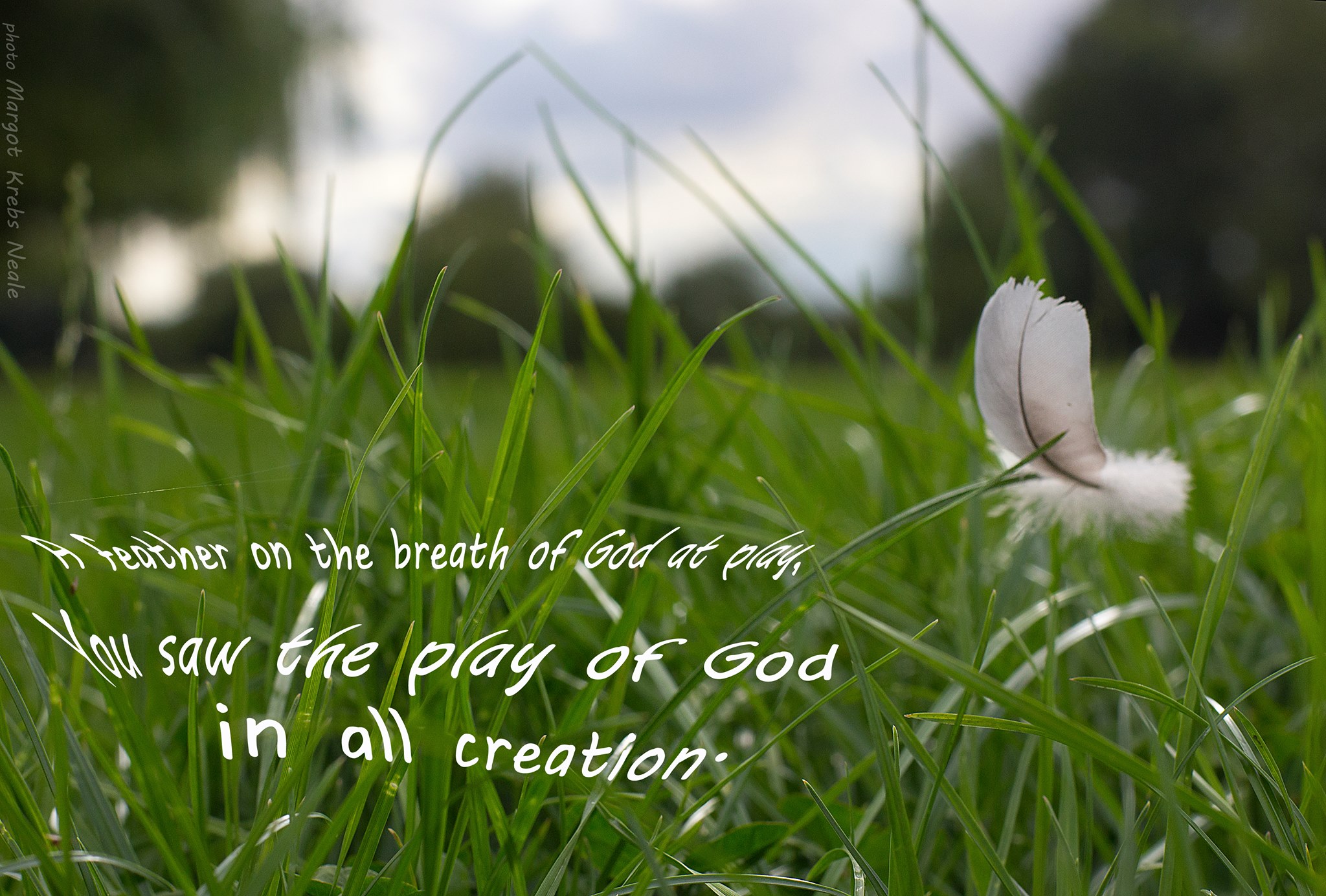
Photo by Margot Krebs Neale

Tuesday, 11 July 2017

Benedict - author of The Rule, founder of Western Monasticism

From the blog of Malcolm Guite

A sonnet for St. Benedict

20130710-093249.jpg
On July the 11th the Church celebrates the feast of St. Benedict of Nursia, the gentle founder of the Benedictine order and by extension the father of Monasticism. A moderate and modest man he would have been astonished to learn that his ‘simple school for prayer’, his ‘modest rule for beginners’ led to the foundation of communities which kept the Christian flame alight through dark ages, preserved not only Christian faith, scripture, and culture,but also the best of Classical Pagan learning and culture, fed the poor, transformed societies, promoted learning and scholarship, and today provides solace, grounding, perspective and retreat not only to monks and nuns but to millions of lay people around the world.
Here is my sonnet for Benedict, drawing largely on phrases from the Rule, I dedicate it to the sisters at Turvey Abbey. It appears in my second book with Canterbury PressThe Singing Bowl
As always you can hear the sonnet by clicking on the ‘play’ button or the title.
Audio Player

You sought to start a simple school of prayer,
A modest, gentle, moderate attempt,
With nothing made too harsh or hard to bear,
No treating or retreating with contempt,
A little rule, a small obedience
That sets aside, and tills the chosen ground,
Fruitful humility, chosen innocence,
A binding by which freedom might be found
You call us all to live, and see good days,
Centre in Christ and enter in his peace,
To seek his Way amidst our many ways,
Find blessedness in blessing, peace in praise,
To clear and keep for Love a sacred space
That we might be beginners in God’s grace.

Wednesday, 1 January 2014

Happy New Year to all the friends of the Ballarat Interfaith Network - "Go into the darkness and put your hand into the hand of God"

This post was originally published on The Trad Pad on  2 January 2011.  
Happy New Year everyone ... 
particularly to those who did it tough this year.  
Please take on board the thoughts of Minnie Louise Haskins
~~~~~~

Happy New Year! May the year be kind to you and bring you blessings, wisdom, peace, and prosperity!  The last day or two has exhibited some coincidence. Firstly, Hay Quaker published, in toto, the poem The Gate of the Year by Minnie Louise Haskins.
Minnie Louise Haskings - The gate of the year
 Minnie Louise Haskins
I said to the man who stood at the gate of the year,
"Give me a light that I may tread safely into the unknown."
And he replied, "Go into the darkness and put your hand into the hand of God.
That shall be to you better than light and safer than a known way!"
So I went forth and finding the Hand of God
Trod gladly into the night.
He led me towards the hills
And the breaking of day in the lone east.
So heart be still!
What need our human life to know
If God hath comprehension?
In all the dizzy strife of things
Both high and low,
God hideth his intention.
Perhaps readers have heard this poem, or part of it, before.  It was made famous by the Christmas Speech of King George VI delivered in 1939.  You can hear the actual speech – it is quite moving given it is made at the time of the first Christmas of World War II – here.
the-kings-speech -the movie
Secondly, I decided to get out of the house for the first time since  Christmas Midnight Carols and Eucharist at All Saints, Mitcham and go to see the much lauded movie, The King’s Speech. It is the story of the relationship between the Australian speech therapist, Lionel Logue, and King George VI.


The movie is being tipped as a frontline contender for an Oscar. In spite of competition from The Social Network in the bookies’ odds as set out here, it is hard to see how this movie could lose with its high proportion of former Academy Award winning actors.  The UK still produces the best actors – particularly in ensemble work as demonstrated in The King’s Speech – in the English speaking world.  However, it does an Australian heart good – particularly one coming from Queensland – to see and hear Geoffrey Rush mixing it admirably with such a talented cast. To think, this great man of Australian movies was growing up across Brisbane from me in the 1950s!

Those sitting around me in the packed movie theatre were clearly as impressed as I. 

I was however surprised at the ending. I don’t think, in such an historical movie, it is giving away much to describe the ending of this movie.  I thought the movie somehow would finish with the 1939 Christmas Speech. This is arguably the most famous, most remembered, and most quoted of all the King George VI’s speeches.  This doesn’t happen.  The movie concludes with the King’s Speech at the beginning of World War II.

Friday, 22 November 2013

Poetry, Music, Food, and an Ancient Oak conclude The Tree of Life Project


To-morrow, Saturday - from 2pm-4pm, 
there will Poetry at The Known World Bookshop
14 Sturt Street, Ballarat. 
(a bookshop to die for!). 


Local published Ballarat poets Barry Breen, Ross Gillett, and Lorraine McGuigan will entertain you. The Known World is a wonderful experience so please take note of the books. You may even want to purchase one or two. 

And the TKW chatelaine Michelle does lovely coffee and bikkies too. All this is part of Ballarat Interfaith Network's The Tree of Life Project - Ballarat's all-inclusive, end-of-year, community-wide celebration.

Then it will be a dash over to the Ballarat Botanical Gardens for The Finale - singing from Like Honey (from Geelong), food, and perhaps a visit to the Druid's Oak planted in 1870!
See you there!

Thursday, 12 September 2013

Poetry Week 2013 - Come, Come, Whoever You Are by Rumi

From Brigid:
Over the years, I have shifted house many times.  As a former librarian, I am good at weeding out bookshelves.  As, in my later life, my homes have got smaller space has been a real issue.  So what I am down to now is what I consider the barest of bare essentials --- perhaps.  Among these books that I consider spiritually valuable are the Essential Rumi - translations by Coleman Barks with John Moyne and Essential Sufism - edited by James Fadiman & Robert Frager. If, having been fascinated by the meditative and mystical poem below, you want to read more of Rumi, please go here.  Each year in Melbourne the Mevlevi Order hold a Remembrance of Rumi which is a wonderful meditative experience complete with whirling dervishes.  To find out more about Sufism and the Mevlevi Order - one of a number of Orders within Sufism - please go here.  For more serious delving, one of the best known of the writers of Sufism is Idries Shah.  Please go here for bio and a booklist.

Come, Come, Whoever You Are

Wonderer, worshipper, lover of leaving.
It doesn't matter.
Ours is not a caravan of despair.
Come, even if you have broken your vow


a thousand times

Come, yet again, come, come. 

Thursday, 5 September 2013

Poem by Nurit Zarchi - How to count to 5774

It can be difficult to step outside our very own selves and our very own culture, traditions, and faith and into the world of the other - other cultures, traditions, faiths.  To catch the flavour of Jewish New Year, Rosh Hashana, here is a poem just published in the Israeli newspaper, Haaretz.


Poem of the Week / How to count to 5774

This Rosh Hashanah, 

Israeli poet Nurit Zarchi suggests a different way of looking at the passage of time.


By Vivian Eden Sep. 3, 2013 | 4:56 PM 

Piling up its seconds, moments, months,
life hides our losses from us.
The miniature palm in the courtyard,
without my help, reached the window,
victorious green flag.

But at the same time that a sick person folds
back into his fate, also the injured are sorry.
These have their own time, not made of moments or days
but of one clear stretch like a night in a town at the pole.

The method for counting changes, not measured by a clock or a calendar,
but the number of telephone conversations, invitations to coffee,
words from across the sea or that you forgot for a moment.

How did I arrive on this smooth and constant track
like that bearing luggage at the airport.
Simply by not being careful
I gave my life to the moments, to the days, to the years.
 

Translated from the Hebrew by Lisa Katz. 
Published in Hebrew in "The Soul is Africa," 
page 34 (Hanefesh heAfrika, Hakibbutz Hameuchad, 2005).


These are the days of posting up new calendars for the Hebrew New Year. Here Nurit Zarchi, an Israeli poet born in Jerusalem in 1941, suggests another way of looking at the passage of time, rather than by days, weeks and months.

The protagonist of this poem is “life,” which not only “hides our losses from us” but also accomplishes things without our intervention. In the second stanza, the speaker contemplates the “sick” and the “injured” (not only in the physical sense), for whom time seems like a long continuum not broken up into discrete units. This notion is expanded in the third stanza: Here we do not have constant units like hours, days or months, but rather a growing number of non-identical events – “the number of telephone conversations, invitations to coffee, / words from across the sea or that you forgot for a moment.” It is a counting rather than a measuring.

In the final stanza, the speaker places herself firmly on this unbroken continuum, comparing it to a baggage conveyor belt, and wonders how she got there. Her answer: “Simply by not being careful / I gave my life to the moments, to the days, to the years.” In other words, by living in the present.

Zarchi has written novels, short stories, books of poetry, an essay collection, an autobiography and over 100 books for children. She is the recipient of many literary awards.

The translator of this poem, Lisa Katz, is an American-Israeli poet and translator who has lived in Jerusalem for 30 years. Her translations of Hannan Hever's "Suddenly the Sight of War: Hebrew Poetry and Nationalism in the 1940s" and "Late Beauty: Poems of Tuvia Ruebner" are forthcoming in the U.S. in 2014.

“It's always a bit of a gamble to translate Nurit Zarchi," Katz tells Haaretz. "She is incredibly prolific, an indefatigable re-writer and also a person who often tosses what's left into a trashcan."

See more of Zarchi’s poetry translated by Katz here.

Musings
*The “miniature palm in the courtyard” in “Calendar” seems to suggest that Zarchi’s poem is in conversation with “Of Mere Being” by Wallace Stevens. How so?

~~~~~~~~~~~~
About Lisa Katz - from Poetry International Rotterdam:
Lisa Katz was born in New York and studied at the University of Michigan and the City College of New York, receiving a PhD (on the poetry of Sylvia Plath) from the English Department of the Hebrew University in Jerusalem, where she has lived since 1983. Reconstruction, a volume of her poetry in Hebrew translation, was published in 2008 by Am Oved Press in Israel; also in 2008, she was awarded the Mississippi Review Poetry Prize and a Ledig House International Writers Residency. Her poems appeared most recently in the Jewish Quarterly of LondonLook There: The Selected Poems of Agi Mishol, in her translation from the Hebrew, was published in the US in January 2006 as a Lannan Foundation selection of Graywolf Press. Her translations of Admiel Kosman were published in 2011 in a bilingual edition entitled Approaching You in English from Zephyr Press. Late Beauty, a bilingual edition of the work of Tuvia Ruebner, translated with Shahar Bram, is forthcoming. Katz taught literary translation at Hebrew University for a decade and is teaching at Ben Gurion University of the Negev in Spring 2013.

Links:
Article by Lisa Katz about Israeli poetry in www.tabletmag.com
Poems in The Drunken Boat
Poems in Blue Fifth Review

Poet and translator Rami Saari, founding Israeli national editor, 2002–2006, was born in Petah Tikva (Israel) in 1963. He studied at the universities of Helsinki, Budapest and Jerusalem and received his PhD degree in Semitic languages. Saari has published six books of poetry: Behold, I Found my Home (1988), Men at the Crossroads (1991), The Route of Bold Pain (1997), The Book of Life (2001),So Much, So Much War (2002), and The Fifth Shogun (2005). In addition, he has translated more than thirty books into Hebrew, both prose and poetry, mainly from Albanian, Finnish, Greek, Hungarian and Spanish. Saari has twice won the Israel Prime Minister's literary award for poetry (1996 and 2003), and the Olschwung Foundation Award in 1998.

Links:
OSU Hebrew Writers Listing
Biography and poems in Hebrew
Biography in English
Poem: 'The Only Democracy in the Middle East'
Poems:'In a Remote Village', 'Documentation'
Biography in Catalan


Friday, 2 August 2013

Wisdom and knowledge gained ... Beside the Creek

A blog can take many forms. So can an interfaith organisation.  So to begin, the first post is in a reflective mood.  It is a poem from which this blog takes its title ... Beside The Creek.  The poem is by the great Australian poet, Judith Wright. Wright was in her lifetime a significant environmentalist.  From both her literary works and her environmental advocacy, we can see that she was a person who was immersed in the Australian landscape in all its variety and forms.  Beside The Creek is a reflective poem.  It is written in the first person and in a reflective tone.  The "I" of the poem writes from the perspective of having been on a journey in which wisdom was learned.  The "I" now has a more mature knowledge which means actions are now different because of the wisdom and knowledge gained.  May our reflections have similar results.

Beside the Creek
by Judith Wright 
Under the wavering water shine the stones,
rounded in ruby-colours and clouded white.
Once I walked barefoot into that cool
Never-ceasing flow. I gathered once
Pebbles and ripples, the skimming rounds of light,
And took them home.

Now I am no such fool,
no such blest and envied stupid child
as to believe those colours, that once dry
gathered dust on a top shelf, heavy and dull
as pages written, pages forgotten and filed.
Here on the bank I sit unmoving; I
know the ungathered alone stays beautiful
and the best poem is the poem I never wrote.

Or so I said, watching the summer through.
But oh – years, time, you hoarsen here a throat
that sang all day without suspecting you;
stiffen the hands that gathered rubies then,
and open now, to show this dubious stone.

The poem can be found in -
Judith Wright - Collected poems  1942-1970
(A & R Modern Poets)
1971