Showing posts with label Writers & Writing. Show all posts

Wednesday, 22 August 2018

The House of Islam : a global history by Ed Husain

A fascinating and revelatory exploration of the intricacies of Islam and the inner psyche of the Muslim world from the bestselling author of The Islamist

'Islam began as a stranger,' said the Prophet Mohammed, 'and one day, it will again return to being a stranger.'
The gulf between Islam and the West is widening. A faith rich with strong values and traditions, observed by nearly two billion people across the world, is seen by the West as something to be feared rather than understood. Sensational headlines and hard-line policies spark enmity, while ignoring the feelings, narratives and perceptions that preoccupy Muslims today. 

Wise and authoritative, The House of Islam seeks to provide entry to the minds and hearts of Muslims the world over. It introduces us to the fairness, kindness and mercy of Mohammed; the aims of sharia law, through commentary on scripture, to provide an ethical basis to life; the beauty of Islamic art and the permeation of the divine in public spaces; and the tension between mysticism and literalism that still threatens the House of Islam. 

The decline of the Muslim world and the current crises of leadership mean that a glorious past, full of intellectual nobility and purpose, is now exploited by extremists and channelled into acts of terror. How can Muslims confront the issues that are destroying Islam from within, and what can the West do to help work towards that end?

Ed Husain expertly and compassionately guides us through the nuances of Islam and its people, contending that the Muslim world need not be a stranger to the West, nor its enemy, but a peaceable ally.

ABOUT THE AUTHOR

Ed Husain is the author of The Islamist, a memoir of his time inside radical Islamism. Having rejected extremism, he now advises governments and political leaders on Islam. He is a senior fellow at Civitas, Institute for the Study of Civil Society in London and a global fellow at the Woodrow Wilson International Centre in Washington DC. He was a senior fellow for Middle Eastern studies at the Council on Foreign Relations (CFR) in New York for five years and co-founded Quilliam, the world's first counter-extremism think-tank in Britain. He has written for the New York Times, the Telegraph, the Financial Times and appeared on CNN, BBC, and others. He lives in London.

@Ed_Husain

Tuesday, 5 December 2017

Little Gidding: and T.S. Elliott, Nicholas Ferrar, Susan Grey. A tribute from Malcolm Guite.

A Sonnet for Nicholas Ferrar of Little Gidding, on his feast day

by malcolmguite

Little Gidding and Nicholas Ferrar's monument


Nicholas Ferrar
Nicholas Ferrar

The Church of England keeps December 4th as the feast day of Nicholas Ferrar, the devout Anglican who founded the Community of Little Gidding in the early seventeenth century. Ferrar was trying to find a fruitful via media between protestant and catholic understandings of what it is to be Christian. As a member of a reformed church he and his community were devoted to reading the scriptures in their own language, to sharing their faith, and to worshipping together in the beautiful services of the Book of Common Prayer. But he was also keen to preserve and explore the Catholic heritage of community life, the daily offices of prayer, and praise, the pattern of Benedictine work and prayer, rooted in the psalms and the gospels. in holding these together he was recovering and preserving what he called. 'The right good old way'. His great friend George Herbert, from his death bed sent Ferrar the manuscript of all his poems, and it was Ferrar who published them for all of us. In the 1930s TS Eliot visited Little Gidding, and eventually enshrined the experience of prayer and awareness granted him there, in the poem Little Gidding, the last of the Four Quartets.
Ferrar died on the 4th December 1637, the day after Advent Sunday, at 1 am, the hour he had always risen for prayers, and my sonnet touches on that. Certainly the place in which he and his community kept prayer going at all times, recited the psalms, and lived out their gospel harmony, is still soaked in prayer, still, a place through which the eternal light shimmers into time, still, as the inscription on the chapel says, 'The very gate of Heaven'.
I would like to dedicate this sonnet to the memory of Susan Gray, a friend and parishioner who loved Little Gidding, both the place and the poem. When I took her last communion to her in the Hospice, she spoke the line from Little Gidding 'In my end is my beginning'.
As always you can hear the poem by clicking on the title or the 'play' button.
2187029-for-nicholas-ferrar.mp3
For Nicholas Ferrar

You died the hour you used to rise for prayer.
In that rich hush beneath all other sounds,
You rose at one and took the midnight air
Rising and falling on the wings and rounds
Of psalms and silence. The December stars
Shine clear above the Giddings, promised light
For those who dwell in darkness. Morning stirs
The household. From the folds of sleep, the late
Risers wake to find you gone, and pray
Through pain and grief to bless your journey home;
Those last glad steps in the right good old way
Up to the door where Love will bid you welcome.
Love draws us too, towards your grave and haven
We greet you at the very gate of Heaven.

malcolmguite | December 4, 2017 at 2:38 pm | Tags: AdventchristianityFerrarFour QuartetsGeorge HerbertliteratureLittle GiddingPoetrySonnetsTS Eliot | Categories: imaginationPoems | URL: https://wp.me/pj0Sl-1fj    See also:  https://en.wikipedia.org/wiki/Little_Gidding_(poem)


Wednesday, 23 August 2017

Terror within and evil without : our capacity for transformation as individuals & nations

From The Editor, one of the most precious sites on the internet is Brain Pickings, masterminded by the wonderful Maria Popova.  There is so much in BP to feed the intellect and the spirit.

The Terror Within and the Evil Without: James Baldwin on Our Capacity for Transformation as Individuals and Nations

“The self,” the poet Robert Penn Warren observed in his immensely insightful meditation on the trouble with “finding yourself,” “is a style of being, continually expanding in a vital process of definition, affirmation, revision, and growth, a process that is the image, we may say, of the life process of a healthy society itself.” Indeed, if the great humanistic philosopher and psychologist Erich Fromm was correct, as I believe he was, in asserting that self-love is the foundation of a sane society, our responsibility to ourselves — and to our selves — is really a responsibility to one another: to know our interiority intimately and hold our darkest sides up to the light of awareness. But part of our human folly is that we do this far less readily than we shine the scorching beam of blameful attention on the darknesses of others.
That is what James Baldwin (August 2, 1924–December 1, 1987) explores in a magnificent 1964 piece titled “Nothing Personal,” found in The Price of the Ticket: Collected Nonfiction (public library) — the indispensable volume that gave us Baldwin on the creative process and his definition of love.
James Baldwin (Photograph: Sedat Pakay)
A year after he contemplated “the doom and glory of knowing who you are and what you are,” Baldwin writes:
It has always been much easier (because it has always seemed much safer) to give a name to the evil without than to locate the terror within. And yet, the terror within is far truer and far more powerful than any of our labels: the labels change, the terror is constant. And this terror has something to do with that irreducible gap between the self one invents — the self one takes oneself as being, which is, however, and by definition, a provisional self — and the undiscoverable self which always has the power to blow the provisional self to bits.
Echoing Bruce Lee’s assertion that “to become different from what we are, we must have some awareness of what we are,” Baldwin turns his critical yet uncynical intellect toward our capacity for self-transformation — the most difficult and rewarding of our inner resources comprising our collective potentiality:
It is perfectly possible — indeed, it is far from uncommon — to go to bed one night, or wake up one morning, or simply walk through a door one has known all one’s life, and discover, between inhaling and exhaling, that the self one has sewn together with such effort is all dirty rags, is unusable, is gone: and out of what raw material will one build a self again? The lives of men — and, therefore, of nations — to an extent literally unimaginable, depend on how vividly this question lives in the mind. It is a question which can paralyze the mind, of course; but if the question does not live in the mind, then one is simply condemned to eternal youth, which is a synonym for corruption.
Complement this particular portion of the wholly invigorating The Price of the Ticket with pioneering social scientist John Gardner on the art of self-renewaland Tibetan Buddhist nun Pema Chödrön on self-transformation through difficult times, then revisit Baldwin on freedom and how we imprison ourselvesthe artist’s strugglethe writer’s responsibility in a divided society, and his increasingly timely forgotten conversations with Chinua Achebe about the political power of art, with Margaret Mead about identity, race, and the experience of otherness, and with Nikki Giovanni about what it means to be truly empowered.

Multifaith? Spiritually independent? Prayer guides for you ...

The material below has been excerpted from here. Please go to the linked website to find even more material. The material below is merely a glimpse, a taste.

Many people today are creating their own prayer books, collecting in a journal or a computer file favorite prayers from childhood, congregational experiences, retreats, and personal reading. Those of us on a multifaith or spiritually independent path are discovering that we are heir to all the devotional practices and resources of the world's religions, including a wide variety of prayers. The following resources provide access to this rich heritage with new and old prayers that approach life's experiences and the world around us with faith, love, compassion, justice, forgiveness, reverence, joy, and wonder.

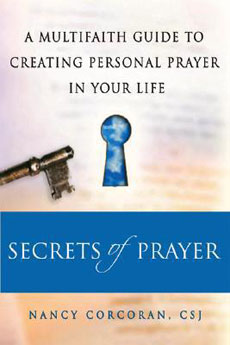
In Secrets of Prayer: A Multifaith Guide to Creating Personal Prayer in Your Life(SkyLight Paths, 2007), Nancy Corcoran notes: "Just as we need physical diversity to survive, we also need spiritual diversity — nourishment from a variety of 'soul foods' — to grow spiritually. No one tradition or way of seeing the Divine will fit every human person or feed every human need. And therein lies another secret of prayer: Diversity in prayer is the food of spiritual growth."

Corcoran is a member of the Sisters of St. Joseph and founder of grass/roots: Women's Spirituality Center. In this excellent multifaith resource, she presents prayer practices from many different traditions, adding some fascinating stories on multiple ways of experiencing the Holy. A chapter on the senses as a vehicle of prayer is filled with many helpful spiritual practices.

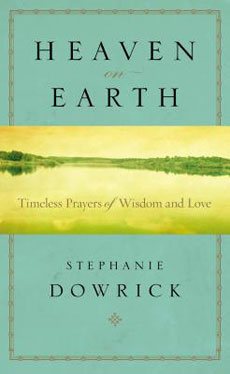
Stephanie Dowrick is a prolific writer, a trained psychotherapist, and a spiritual leader and teacher. In the opening chapter of Heaven on Earth: Timeless Prayers of Wisdom and Love (Tarcher/ Penguin, 2013) she praises prayer as a restorative process that anchors us, brings life back when our faith has faltered, and opens our hearts to the grace in our lives. It also is a very helpful resource in times of illness, loss, grief, and death.
Dowrick offers the following advice on how to pray: pray in the present moment, make the prayer your own, check what motivates you, choose your prayers spontaneously, let instinct guide you, commit to prayer, pray often, and value the miracle. She uses these two quotations as ballasts for the book: "Prayer is a longing of the soul. . . . and an instrument of action" from Mahatma Gandhi and from Rabbi Abraham Joshua Heschel: "Prayer cannot bring water to parched fields, mend a broken bridge, or rebuild a broken city, but prayer can water an arid soul, mend a broken heart, and rebuild a weakened will."
In seven chapters, Dowrick shares a treasure-trove of prayers, quotations, and sacred texts from all the world's religions and spiritual paths, giving the reader a chance to connect with God, the mysteries of human nature, the triumphs and tragedies of everyday life, and the ample wonders of light, love, and personal transformation.

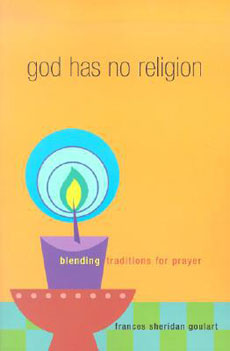
God Has No Religion: Blending Traditions for Prayer (Sorin Books, 2005) by Francis Goulart is the kind of resource that should become a staple in these times when people of many traditions are regularly interacting. Blending traditions for prayer can deepen our own faith, as Karen Armstrong has pointed out: "By learning to pray the prayers of people who do not share our beliefs we can learn at a level deeper than creedal, to value their faith."

Saturday, 19 August 2017

CALL OUT BY THE PLANETARY HEALING ARTISTS ASSOCIATION OF AUSTRALIA INC TO PLANETARY HEALING ARTISTS

PHAAA - Planetary Healing Artists Association of Australia inc. 
is a not for profit organization that creates a forum for artists including visual artists, performers, writers, healers, 
and other creatives in the community to share ideas for a sustainable future in a creative way. 
The main purpose is supporting an environmentally sustainable planet

WE WELCOME YOU TO JOIN US at 7.30pm, 
1st Thursday bi-monthly upstairs at St Kilda RSL, 
88 Acland Street, St Kilda


We are forwarding this email to invite Faith/Spiritual artists to exhibit to our upcoming art exhibition, One World.

There are 2 weeks to go now for submission forms to be in by 5th September 2017.
'One World', art exhibition is dedicated to world peace and will celebrate spirituality, faith and belief. It will explore the common connections between people with diverse beliefs, and promote the idea that by uniting for a common vision of a better world for all, that together we can make a difference. It is our hope that the exhibition will promote greater understanding and compassion in the broader community.

The exhibition will open on UN International Peace Day, 21st September 2017 and will run until 29th September at 4Dverse Gallery in St Kilda (1/118A Carlisle St - opposite the Town Hall).

We are calling for artworks along these themes in a variety of visual art mediums, representing a diverse range of beliefs and faiths. Submissions are due on 5th September (see attached for a flyer and submission form) and will be selected by a Panel curating the exhibition. 

Please share this email with your networks and let us know if you would like to exhibit your artwork.

Blessings
Maria
for the Planetary Healing Artists Team

www.planetaryhealingartists.org

Volunteers always win...  the more you get to act, the more opportunities you create. Raise your hand. Step forward. Step up. You'll be glad you did.  Jeff Haden


Saturday, 27 February 2016

Parabola interviews the great interfaith voice - Karen Armstrong

O
ne bright spring day, Parabola met with Karen Armstrong  in her suite at the Parker Meridian hotel in Manhattan.  The petite, friendly 62-year-old British ex-nun, arguably the most influential commentator on religion in the English-speaking world, was on tour to promote her latest bestselling book.  Lauded by critics as “magisterial” and “magnificent,” The Great Transformation chronicles the vast movements of history that comprise what philosopher Karl Jaspers termed the Axial Age, the period between 900 to 200 B.C.E. when most of the great religions in humanity either came into being or grew their roots.  Armstrong traces the arising of Confucianism and Taoism in China; Hinduism, Buddhism, and Jainism in India; Monotheism in Israel, and the flowering of Philosophical Rationalism in Greece.  She tracks this huge swath of history with verve and lucidity, noting that each of these very different traditions arose during periods of political disruption, religious intolerance, and violence.
Armstrong came to international prominence in 1993 with the publication of The History of God, a searching and profound history of the rise of the three major monotheistic faiths.  The one-time Roman Catholic nun wrote of the evolution of God in Judaism, Christianity, and Islam in a way the earned her a reputation as a practitioner of “negative capability”—she is at once an iconoclast and a bridge builder between traditions.  Her latest book expands and illuminates her message about the dangers of emphasizing an adherence to religious doctrine over the practice of compassion—which she presents as the most profound discovery of the Axial Age sages and the fundamental teaching of all true religions. Armstrong is an inspiring example of one who uses study—and bracingly independent critical thinking–as a way to draw closer to God.
—Tracy Cochran
Parabola: Can you describe the Axial Age and the light it might shed on the difference between thinking and knowing? I realize I’m asking you to traffic in huge generalities here, but it seems to be a pivotal distinction.
KAREN ARMSTRONG: You were supposed to get underneath thinking. In India in particular, the concern was that thinking as well as feeling were not what constituted the deepest self of the human being, that it was something other. This didn’t mean that they weren’t interested in being intelligent and rigorous and analytical, but the goal was to go beyond thought. People in the Axial Age were reaching out for an ultimate reality—and it could be called Brahman or God or Nirvana or the Tao—that couldn’t be encapsulated in human thought and language.
P: Why can’t it be encapsulated?
KA: Because human beings experience transcendence. We have ideas and experiences that go beyond our conceptual grasp.
P: Does rational thought blind people to the elusive aspects of our experience?
KA: No. We need rational thought. Plato described the two different ways of approaching truth as mythos and logos. Mythos is a more silent, intuitive way of looking at reality and logos is more of a scientific, discursive, logical way, and we need both. We’ve always needed logistic thought, if only to sharpen an arrow correctly.
P: But we need mythos as well.
KA: Yes. When a child dies, we want a scientific explanation but that’s not all we need. We need some kind of different kind of thinking that helps us deal with the turbulence of our inner world at such a time. Myth is an early form of psychology. There are all these stories about gods going down into the underworld to slaughter demons. We all have to learn how to negotiate our unconscious worlds. We have to go into the labyrinth of our own selves and fight our own monsters. We’ve always been aware that there are two ways of approaching truth, one through reason and science and the other through an intuitive knowing. The word mythos comes from the Greek word which means to close the mouth or close the eyes. Mystery and mysticism come from the same root. So they are associated with a sense of darkness, with going into a realm where you don’t see very clearly, where things are more obscure and will remain obscure. It is also a realm of silence rather than wordy thought. We approach this kind of knowing in art. At the end of a great symphony or when you’ve listened to a great poem there’s often nothing to say. You’re being pushed beyond rational thoughts and distinctions into a silent intuitive space.
P: What is the proper role of thought in religious search?
KA: Well, thinking can only take you so far. Action, behavior, especially compassionate behavior, is more important than thinking. By constantly exercising compassion, the golden rule, you enter a different state of consciousness. This rather than thinking will get you to enlightenment.
P: It’s amazing that all the religious movements came to that same conclusion. But can it be that simple?
KA: Yes. The Buddha said compassion can bring you the release of the mind. This is a synonym in the early Buddhist scriptures for the ultimate enlightenment of nirvana. The New Testament is full of the same wisdom. Charity and loving kindness bring you into the presence of God, not thinking things. In the Western Christian world we’ve come to place too much emphasis on thinking certain beliefs. What the sages in the Axial Age were discovering was second order thinking, where you watch the mind thinking. Socrates for example could make you realize that what you don’t know what you think you know. He demonstrated that thought can do a whole lot of things but that it always finishes with unknowing. Socrates could take a person through a series of questions until he realizes that he hasn’t a clue what, say, courage is, even though he’s been on the battlefield. Often the people who came to Socrates–as far as we can tell from Plato’s accounts–thought they knew their minds. After ten minutes with Socrates they realized they didn’t know anything. In the Axial Age people were testing the limits of what thought can do. It can take us a long way but we keep bumping up against an unknowing. Socrates said that is where you really begin your quest, when you realize you know nothing.
P: You’re talking about a very fertile kind of not knowing, not just obliviousness, not just stone ignorance.
KA: Yes, and it’s a humbling thing. Instead of being full of ourselves, we begin to realize that the world is deeply mysterious and elusive. We realize that we haven’t got the tight grasp on reality that we think.
P: In this book and in all your writing you make a distinction between belief and this more fertile state.
KA: We’ve made a fetish of belief in the Western Christian world, so that we call religious people “believers,” as though accepting certain doctrines is the main thing they do. But this is very eccentric.
P: And dangerous, as you’ve pointed out in your writings, about the way fundamentalism leads to violence.
KA: And dangerous. As the Taoists said way back in the Axial Age, to expect certainty from religion is immature and unrealistic. It was a sign of an undeveloped spirituality, a childish viewpoint. There is no certainty.  The Taoists found a great freedom in not being certain about things. They didn’t have to pompously declaim facts and doctrines and truths. Keats spoke of “negative capability,” when the mind is capable of resting in doubts and uncertainty without any irritable straining after facts and reason.  It’s quite a trick of the mind to allow yourself to be in that fertile state of unknowing, to just let yourself stay in the darkness.
P: We’re in a frightening place in world history. Your predictions about religious war have come true, and our whole environment is in a perilous shape. From your study of the origin of the great religious traditions, what really matters?
KA: The exercise of compassion is what matters in our world. The Dalai Lama says “my religion is kindness.” Confucious said “religion is altruism” – dethroning yourself from the center of your world and putting another there. Now this requires intelligent thought. You really have to think and practice the golden rule about what the other person really wants rather than what you think he ought to want. When we speak to people we should behave as Buddha or Socrates did. Address them where they really are and not where we think they should be.  We have to put ourselves in the place of another, and we have to be able to do this globally.
P: This state of compassion, of engagement, does take thinking.
KA: It does. It takes constant, flexible intelligence.  Each case will be different so principles are really not the point.  You have to be flexible to respond to each situation that arises especially in a time where everything is changing so fast. We have to investigate.  We have to find out more about the world. I’ve had some extraordinary conversations with highly educated Americans who have asked me where the Palestinians have come from, as if they marauded in off the desert.  I’ve had to explain Palestine. There is so much ignorance. All the great sages have said that we must see things as they really are. Don’t bury your head in the sand and say that environmental catastrophe isn’t going to happen, for example. In the Axial Age, the prophets of Israel called those positive thinkers who thought that Jerusalem was not going to fall because God was with them “false prophets.” You cannot achieve enlightenment that way. It takes information gathering and that does not mean being content what the little scraps of sound bytes that are handed out by politicians or Fox News.
P: Often, in our culture, people treat yoga and meditation like a kind of spa treatment. Our practice of the precepts doesn’t keep pace with our practice of various techniques.
KA: Absolutely. I saw a place in Toronto called the yoga lounge, next to a nail parlor. You could do a little yoga or meditation and hop in to have your nails done. This is not what yoga is. In the Axial Age, it was based on a five-point moral program. At the top of the list was ahimsa or nonviolence. This did not only mean that you couldn’t kill or maim somebody but that you weren’t to say a cross word or make an impatient gesture or swat an insect. Until your guru was satisfied that this was second nature to you, you couldn’t begin to sit in the yogic position. What religious knowledge was about was not just thinking but behaving. Living a self-effacing, nonviolent life style was just as important as your mastery of sacred texts.

P: In your book you describe an evolution from external blood sacrifice to internal sacrifice–and in the case of Buddhism, to sacrifice of the concept of self. Yet when I think of living this way, completely open, defenseless, radically honest, it’s as if certain primal emotions come alive. The ego doesn’t want to be sacrificed, to be killed.

KA: Yes, but when you’ve mastered this way of life you start to experience incredible joy because you’re training yourself to go beyond the frightened ego, who often needs to destroy other people and bolster itself up. If you let that go, a lot of your fear goes down. We are programmed to defend ourselves, but if we take ourselves out of that mind state, if we start divesting ourselves of ego, we enter a different state of consciousness.
P: What came through your book is the emergence of another way of thinking—with conscience. You cover huge swaths of history in detail. Yet, there’s a beautiful base note of compassion. It comes through as the last word, the ultimate religious act.
KA: The point is that there was no collusion. This is the conclusion reached by these spiritual geniuses who worked as hard at finding a cure for the spiritual ills of society as we are working to find a cure for cancer. This is the conclusion they came to. Not because it sounded nice but because they found it worked. The Buddha always said, “Test my teaching against your experience.”  They found that if you did live in this way you experience an enhancement of being. The Chinese Confucians spoke of human heartedness, of becoming more humane.

P: Axial sages thought the heart and mind should work as one.

KA: Yes.
P: So what happened?  How did these wonderful insights of the Axial Age harden into rigid principles and hierarchy?
KA: Well of course not many people actually want to be transformed. They don’t want to lose themselves. Most people expect from religion a little moral uplift once a week.
P: We live in the place and the age when religion has become another consumer item or service.
KA: Yes, it is a commodity. People say wouldn’t it be great if there was another Buddha. But I’m not sure such a great sage could manage today. The media and the exposure could easily destroy them, encouraging narcissism, for example.
P: How do we find our way out of this trap of spiritual materialism?  Can we think our way out?
KA: Basically, I don’t think we need any great figure to come along. We know what to do.  The golden rule, that’s all it is.  All the traditions teach the same. Instead of waiting for some lead,  just go on, just start practicing. And perhaps start demanding it from our politicians and religious leaders, too.

P: That is a radical suggestion.

KA: But everybody knows about the golden rule or compassion. “I may have faith that moves mountains,” says St. Paul. “But if I lack charity it’s worth nothing at all.” And then there’s imagination, which is the ability to think yourself into the position of another.

P: We tend to minimize imagination, as if it has to do with fantasy, distraction.

KA: I think it is the religious faculty. The religious imagination is endlessly trying to envisage the eternally absent God, that which always eludes us. I think it’s the moral faculty too, because you have to use it to think yourself into the position of the other.
P: What you’re saying is extraordinary because there is such a strong tendency to go on facts, to stick to life as it is, and yet we really can’t.
KA: We can’t because this is part of the way our minds go. We keep bumping up against mystery. There’s great enlightenment to be had by accepting that, and if everybody did it the world would be a much better place.♦
From Parabola, Vol. 31, No. 3, Fall 2006: Thinking. This issue is available to purchase here. If you have enjoyed this piece, consider subscribing.

Saturday, 27 June 2015

More for Ramadan 2015 - Ramadan Reads

From The God Article
Ramadan 2015
bestof2014


Ramadan Mubarak! 

Ramadan is now in full swing, a month-long holiday on the Islamic calendar
to commemorate the first revelation of the Quran to Muhammad. 

Patheos Muslim bloggers are pleased to share their 2015 Ramadan journeys
 with you on the Patheos Muslim channel,
where you'll find the special #30Days30Writers project 
and great Ramadan reads like these:


  • When Online Muslim Friends Provide Love and Community: A Convert's Ramadan Story by Sarah Ager
  • Fasting in Ramadan to Strengthen the Will for Social Justice by Hakeem Muhammad
  • Growing Up Mosqued, Away From the Masjid by Hind Makki


  • You can also learn more about this holy time on the 

    Saturday, 23 November 2013

    The 50th Anniversary of the death of C.S. Lewis


    Many people in the early 21st Century will only know C.S. Lewis by his children's books in the Narnia series - or by the movies and plays made from them. There is much, however, to explore.


    A visit to the Wikipedia entry on Lewis is a jumping off point 
    into his friendship with J.R.R. Tolkien
    his books on Christianity and the Christian walk. 

    2013 marks the 50th Anniversary of the death of C.S. Lewis.   The ABC's Religion & Ethics website has a reflective piece by the British theologian Alister McGrath.  

    Alister McGrath is presently Professor of Theology, Ministry and Education at King’s College, London. He will take up the Andreas Idreos Professorship of Science and Religionat Oxford University in April 2014.  His most recent book include two substantial studies of Lewis, both based on two decades of research, publish to mark the fiftieth anniversary of Lewis’s death: C.S. Lewis – a Life: Eccentric Genius, Reluctant Prophet and The IntellectualWorld of C.S. Lewis.

    Does C. S. Lewis Have Something to Hide? - a review

    Monday, 7 October 2013

    Oh to be in New York just when Eagleton is there!

    The title of this post expresses how I felt when I saw this information.  For those readers of Beside The Creek who are not familiar with Terry Eagleton, this post serves to provide a starting point for your introduction to him and his work.

    ~~~~~~~~~~

    Dawkins, Hitchens and the New Atheism

    Eagleton has become a vocal critic of what has been called the New Atheism. In October 2006, he published a review of Richard Dawkins's The God Delusion in the London Review of Books. Eagleton begins by questioning Dawkins's methodology and understanding: "Imagine someone holding forth on biology whose only knowledge of the subject is the Book of British Birds, and you have a rough idea of what it feels like to read Richard Dawkins on theology". Eagleton further writes, "Nor does [Dawkins] understand that because God is transcendent of us (which is another way of saying that he did not have to bring us about), he is free of any neurotic need for us and wants simply to be allowed to love us."[14] He concludes by suggesting Dawkins has not been attacking organised faith so much as a sort of rhetorical straw man: "Apart from the occasional perfunctory gesture to ‘sophisticated’ religious believers, Dawkins tends to see religion and fundamentalist religion as one and the same. This is not only grotesquely false; it is also a device to outflank any more reflective kind of faith by implying that it belongs to the coterie and not to the mass. The huge numbers of believers who hold something like the theology I outlined above can thus be conveniently lumped with rednecks who murder abortionists and malign homosexuals."[15]

    Terry and Gifford Lectures

    In April 2008 Eagleton delivered Yale University's Terry Lectures with the title of his subject being, Faith and Fundamentalism: Is belief in Richard Dawkins necessary for salvation? constituting a continuation of the critique he had begun in The London Review of Books. Introducing his first lecture with an admission of ignorance of both theology and science Eagleton goes on to affirm, "All I can claim in this respect, alas, is that I think I may know just about enough theology to be able to spot when someone like Richard Dawkins or Christopher Hitchens—a couplet I shall henceforth reduce for convenience to the solitary signifier Ditchkins—is talking out of the back of his neck."[16][17] His "Terry Lectures" were published in 2009, in Reason, Faith, and Revolution.

    Now if that is insufficient to whet your appetite, please pop over to the Wikipedia entry from which the above paragraphs have come. If you scroll to the bottom, you will find the Eagleton book list.  For some other Eagleton information, please go this site.

    Thursday, 12 September 2013

    Karen Armstrong, Charter for Compassion and Peace Starts Here

    Picture above from here

    Karen Armstrong is one of the great contributors to the interfaith scene with a substantial list of written works. Armstrong received the $100,000 TED Prize in February 2008. She used that occasion to call for the creation of a Charter for Compassion, which was unveiled the following year.  In short, Armstrong puts her money where her mouth is.  Armstrong is a clear thinker.  She sits or has sat on a substantial mix of different faith (yes faith not interfaith) organisations. Clearly, she has the confidence of a broad spectrum of faith traditions.  Out of her own personal experience has come a substantial body of work and, in more recent times, something which Armstrong hopes will have a greater on-the-ground effect across the world --- Charter for Compassion

    Charter for Compassion - Peace starts here
    September 10, 2013
    Greetings,
    Inter-cultural dialogue is an open and respectful exchange of views between individuals and groups from different cultures that lead to a deeper understanding. The lack of this is the origin of most conflict.
    I know a little about this. As a mother, I raised three sons, and my parenting skills were most challenged when my sons disagreed and fought over a toy or my attention. I learned in those moments how important it is to teach them peacemaking skills. In fact, given the current state of the world, teaching this skill to young people is our only hope if we are to create a sustainable and compassionate world.
    The Charter for Compassionate Education is an exciting development on this front. Its’ very existence gives credibility to what I, and zillions of other parents, have always known – that integrating compassion into a child’s education is the most important value (s)he will learn and the soil from which all meaningful learning grows.
    Check out the Charter for Compassionate Education featured below, and share it with educators where you live.
    Warm regards,
    Sekai Ayana-Senwosret
    "We urgently need to make compassion a clear, luminous and dynamic force in our polarized world
    ...indispensable to the creation of a just economy and a peaceful global community."
    ~ The Charter for Compassion
    The Compassion Games: Survival of the Kindest co- opetition begins September 11 and runs through the 21st. This year's games are hosted in fifteen cities, from Seattle to Gurgaon, India. The Games are a fun way to engage the community and promote service projects, positive social connection and community pride. There are four ways to play: Service Projects, Random Acts of Kindness, Secret Agents of Compassion and sharing stories on the Compassion Map. The Compassion Games are an example of how the Charter for Compassion is inspiring action around the world. Visit the Compassion Games website to learn how to play and organize your city and play in 2014. Add your hometown to the growing list of players! 
    Raising and Educating Compassionate Children. If you are an educator, parent, guardian or grandparent, don't let another day go by without acting on the Children's Charter for early primary and elementary schools, and the Charter for Compassionate Schools for middle through secondary schools. Learn more about both and find a wealth of materials in our Compassionate Education Reader for thinking about educating, raising responsible children and teaching compassion and other related skills. 
    Research shows that compassionate business practices benefit society and are good for the bottom line. For example A.W.I.S.H. is a new partner, and their mission is to promote sustainable development and quality of life for residents in Nepal, particularly, and across the region in South Asia. A.W.I.S.H, and partners like them, are changing the landscape of business because they are driving both economic and social agendas. If you are not already a partner then why not consider joining our community of 52 business partners who are committed to integrating the principles of the Charter into their business practice. Check out our Prezi to find out why compassion is a new driver for business growth. Then explore our Business Compassion Reader, a comprehensive library of articles related to compassionate business 
    Read about our other 30 healthcare partners and what they are doing from Europe to Asia. Hearts in Healthcare aims to put the care back in healthcare. The Upaya Zen Center is a practice, service, and training center devoted to integrating practice and social action by bringing together wisdom and compassion to the care of others. Public Health England has been established to protect and improve the nation's health and wellbeing, and to reduce inequalities. If you know of healthcare providers and agencies that should be a part of our community, tell them about The Charter for Compassion International.
    My Jihad's mission is to build bridges between faiths. Watch as an Imam goes to church on Christmas Day and how the congregation responds. This is an example of how interfaith actions around the world are changing the dialogue about the role of religion and faith as a catalyst for human cooperation and understanding. We have 95 Charter Partners who are building bridges between faiths around the world, you can also read our Religion and Spirituality Compassion Reader which is a comprehensive resource of the latest articles and ideas shaping the religious and spiritual world. Support the work of our charter partners by first learning more about what they do.
    The global peace and non violence initiative is a cross-sector global community that is reframing how we address conflict inspired by the ideas of the Charter for Compassion. We recently debuted the Peace and Non Violence Compassion Reader containing a comprehensive collection of 'must read' articles and contributions from within the movement. We also have 39 Charter partners who are actively building bridges of peace around the world including Peaceful Tomorrows who are turning grief in to actions for peace. These are great examples of how the Charter is coming to life as movement builders are inspired to create a more peaceful world. 
    Compassion Games run September 11-21

    Check out the website for city specific information. There is a great deal happening in the UK this fall: participate in AnonCare's Enhancing Compassion in Healthcare in Birmingham on September 23, hear Karen Armstrong at St. Paul's Cathedral on September 24, and on October 24 participate in the Empathy and Compassion in Society Conference. Find out about conferences in Belgium, Italy, the Netherlands and the U.S. Visit Events at our Charter site. 
    Poverty and Wealth in America

    An open dialogue on "Poverty and Wealth in America" is running throughout September and October, via in-person and virtual gatherings. The organizers are looking for participants as well as "point people" to help connect and engage members of the Compassion Movement. There is an optional introductory call Saturday September 14th at 8am Pacific/11am Eastern (US time). Click here or email Ben Roberts of The Conversation Collaborative for more information.