Showing posts with label Uniting Church of Australia. Show all posts

Wednesday, 4 July 2018

Spirituality/Secularism in the Parliament of Australia


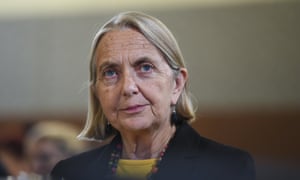
The Greens senator Lee Rhiannon wants the Lord’s prayer to be replaced by a secular statement.
 The Greens senator Lee Rhiannon wants the Lord’s prayer to be replaced by a secular statement. 
Photograph: Lukas Coch/AAP

The Lord’s prayer would be abolished from the start of Senate sittings and replaced by a statement that includes religious and non-religious beliefs, under a push instigated by the Greens.
On Wednesday the Greens senator Lee Rhiannon will move a motion for a Senate inquiry into the proposed alternative: “Senators, let us in silence pray or reflect upon our responsibilities to all people of Australia and to future generations.”
The move is supported in a letter signed by progressive religious leaders including Fr Rod Bower, of the Anglican parish of Gosford, the reverend Margaret Mayman, of Pitt St Uniting church, and rabbi Jeffrey Kamins of the Temple Emanuel at Woollahra.
Guardian Australia understands the Greens believe they have enough support to set up an inquiry. Senators Stirling Griff and Rex Patrick confirmed Centre Alliance will support the motion, although Patrick noted this is “not the same thing as supporting replacing the prayer”.
Griff suggested the alternative prayer “ensures the moment is more relevant and personal for the individual”.
Senate sittings begin with the Lord’s prayer, a Christian prayer including the words “our father, which art in heaven, hallowed be thy name”.
Rhiannon said the statement that opens parliament “should be inclusive of people of all beliefs and faiths”.


“The Greens are suggesting the proposed new opening statement be referred to the Senate’s procedure committee for a public inquiry that better reflects the secular nature of our country and our parliament,” she said.
“A secular nation like Australia should be free from religious bias and not impose religious influence on citizens or parliamentarians.
“We should work for religious tolerance in the structures of government.”
Mayman said it was “time for the Senate to move on from an opening prayer that belongs to the era when Christianity as the majority religion in Australia was given precedence over other faiths and belief systems”.
“It is time to embrace words that are inclusive and respectful of religious diversity,” she said.
“The archaic language of the current prayer suggests that religious ideas are anachronistic and irrelevant in a pluralistic society.
“The use of the Lord’s prayer is not respectful of Christian faith, as it reduces the prayer that Jesus taught his followers to pray to a rote recitation in this context.”
The letter signed by religious leaders notes the Australian Capital Territory’s legislative assembly begins with a similar non-denominational statement.
“We believe this statement more accurately reflects the multicultural nature of our diverse communities,” it said.

Monday, 3 August 2015

Standing united: the 14th triennial Assembly of the Uniting Church in Australia held in Perth - July 2015

 AUGUST 2, 2015

august crosslight cover
More than 300 members of the Uniting Church in Australia met last month at the 14thtriennial Assembly, held in Perth. Church gatherings such as this represent a microcosm of issues facing society. Our relationship with Australia’s First peoples, multiculturalism, same-gender marriage, asylum seeker policies and foreign aid were just some of the subjects discussed throughout the eight days.  This month, Crosslightbrings you a snapshot of news and reflections from Assembly.
All of the August Crosslight stories are available hereCrosslight is also available in digital form, so you can read it from your iPad or tablet device.
If you are not able to get to a Uniting Church congregation but would like to continue to receive Crosslight each month, we can arrange to deliver it to you, whether you are in Australia or overseas. Subscribe here to receive Crosslight in your letterbox every month.

Saturday, 26 July 2014

Greening the Uniting Church

From Crosslight - magazine of the Victorian and Tasmanian Synod of the Uniting Church of Australia. An encouraging and inspiring write-up of how congregations can review the energy consumption of their churches.

~~~

Greening the Church

Solar panels on churchWhen the Synod resolved to reduce energy use by 20 per cent by 2020, many congregations set about working towards ways in which they could live out the commitment to responsible stewardship of the environment.
Whether it is investing in solar power, retrofitting buildings or simply shopping around for the best utilities provider, church groups are increasingly seeking opportunities to lower their carbon footprints.
In 2012 the small team at Glen Waverley Uniting Church started their journey of investigation.
Throughout the next two years, Warren Greenwood, Neil Leister and Ross Lennon reviewed the electrical needs of the congregation and looked at various options to reduce energy use.
They found between 60 to 70 per cent of their annual power usage was in the daytime and 80 per cent of energy usage was electricity.
After consulting a number of solar companies, Glen Waverley UC recently installed a new 30 kW solar electric system. The system will slash their annual power bill by more than half and pay for itself in seven years and will produce free, zero-carbon electricity for at least 20 years.
It was calculated the system would reduce their annual power bill from $14,000 p.a. to between $5000 and $6000. The total cost of the project was approximately $50,000.
An added benefit is that, when the community looks up at the roof of the church, they are seeing a clear – or rather a shiny black – representation of the church’s commitment to the environment.
The Queenscliff-Point Lonsdale congregations have also taken steps to reduce their carbon footprint and lower their bills.
Treasurer Lorel Larcombe was encouraged to review their energy deal after being contacted by the Synod’s new Uniting to GREEN program.
“It could not have been simpler,” Ms Larcombe said.
“I told them we could get a better deal elsewhere, and they immediately offered to review our current plan. They then offered a fantastic additional 20 per cent reduction. This will mean the churches now save nearly $1,000 per year in energy bills.”
Encouraged by these savings, church members are now considering using the money they’ve saved to invest in more green initiatives.
“There is a nice synchronicity about using the savings to fund another green activity, such as solar panels. We are delighted that the serendipitous contact with Uniting to Green has opened up these options,” church secretary Richard Allen said.
Congregations interested in learning more about energy efficiency initiatives are encouraged to make contact with the National Energy Efficiency Network (NEEN).
Michael Hwang, NEEN regional leader for Victoria and Tasmania is based at the synod as another resource to assist congregations to get started on energy reduction initiatives.
Funded by the Federal Government and Department of Industry, NEEN provides information and advice on how to implement energy reduction initiatives.
Mr Hwang said that often the first steps are the most difficult.
“There is so much information out there that it can be daunting to get started,” Mr Hwang said.
“But once you get started there are significant cost savings to be made from simple behaviour changes and low cost initiatives.
“These in turn can support more significant investments like retrofitting or solar panels.”
For more details on Glen Waverley’s project please visit www.gwuc.org.au/solar or contact Warren Greenwood on 9560 3580.
Congregations interested in reviewing electricity and gas energy plans can contact the Uniting to GREEN team at UnitingtoGREEN@victas.uca.org.au or 03 9251 5916.To find out more about NEEN visit www.neen.org.au or contact Michael Hwang on 0417 342 017 or michael.hwang@neen.org.au.

Thursday, 31 October 2013

Reimagining faith communities in a nation of multicultural diversity

From Crosslight, a newspaper published by the Uniting Church Synod of Victoria and Tasmania
19_GiL-oct

To reimagine is to remake, recreate, re-think, or form a new conception of something. Reimagining our future as a multicultural church is what director of the synod’s Cross-Cultural Mission and Ministry unit, Rev SweeAnn Koh is asking UCA members to do.

What does it mean to be a multi-cultural church as we proudly declared ourselves to be in 1985?
This is particularly relevant at a time when our federal government is reimagining multiculturalism. Prime Minister Tony Abbott has eliminated the position of Minister for Immigration, Multicultural Affairs and Citizenship. In its place he has installed a Minister for Immigration and Border Protection, thus removing the word multiculturalism itself.
Australia is a multicultural country – the vast majority of the people who currently call Australia home have ancestry that originated somewhere else.
The irony of the ‘Stop the Boats’ campaign by the coalition is that we are a country full of boat people, or people (or descendants of those) who have ‘come across the seas’ to share in Australia’s ‘boundless plains’. The culture of the First Australians, here for 40,000 years before white settlement, adds another important multicultural element into the mix.
Because of the recent changes made by the government, our responsibility and role to embrace the cultural diversity within our church becomes paramount. So often when the state fails citizens, minority groups and those most in need, the church picks up the slack – but we are not a self-proclaimed multicultural church out of necessity or obligation. We choose to be one because of a belief that these differences are a gift.
The “We Are A Multicultural Church” statement adopted by the 4th Assembly of the Uniting Church in July 1985 states UCA’s belief that; “Christians in Australia are called to bear witness to a unity of faith and life in Christ which transcends cultural and economic, national and racial boundaries… Jesus Christ has made peace between people of every race, culture and class. This unity too is a gift of God, a foretaste of the reconciliation of all things in Christ. It is also a goal to be achieved as we commit ourselves in one fellowship to achieve justice, affirm one another’s cultures, and care for any who are the victims of racial discrimination, fear and economic exploitation.”
Part of reimagining ourselves as a multicultural church is revisiting a model which often sees a wide variety of cultural groups respecting each other’s differences but still remaining quite separate and disconnected.
Mr Koh asks if we are in danger of espousing the idea of multicultural harmony yet only enacting it on a surface level.
To counter this trend, CCMM have created a new program called ‘Below the surface: congregation to congregation partnership’. The program invites two congregations to build an intentional partnership over two years – one congregation comprising predominantly Anglo-Saxon members and the other comprising predominantly CALD (Culturally and Linguistically Diverse) members.
The hope is this program will encourage more congregations to engage on a deeper level with congregations of a different culture in a way that goes beyond lip service or tokenism.
Participating congregations will sign a memorandum of partnership committing to: share combined church council meetings at least twice a year; participate in at least one joint congregational activity per year; keep informed of each other’s specific programs; attend a cross-cultural weekend once a year facilitated by the CCMM unit; celebrate each other’s culturally significant dates and occasions and participate in mutual prayer.
For more information on Mission and Service funding please visit: www.victas.uca.org.au/givingisliving

Friday, 25 October 2013

Thank you to Elizabeth Deutscher for passing this on to Beside the Creek.. It comes from Crosslight, a newspaper published by the Uniting Church Synod of Victoria and Tasmania


Theological diversity within a multicultural church

When we declared in 1985 at the 4th National Assembly that ‘the Uniting Church is a multicultural Church’ we affirmed that we are a diverse church. Diversity is the hallmark of a multicultural church. Many within our church would readily affirm how we are enriched by the cultural, racial and ethnic diversities.
However, there is a diversity that we seldom name or feel comfortable with – the theological diversity that exists within a multicultural church. This is one of the elephants in the room that we dance around.
If the truth be told, I become irritated when I hear someone say: “But this is not Uniting Church theology.” Indeed, what is Uniting Church theology? I know we have the Basis of Union but I am yet to find a document or book that states unequivocally what Uniting Church theology is.
I think there is an assumption within some parts of our church that the Uniting Church subscribes to orthodox theology or normative, transcultural, universal and historic theology. Anything else is considered ‘heretical’ or ‘dumb-down’ theology.
What is often considered ‘orthodox Christian theology’ has been a theology of empire, a theology of colonialism, a theology that powerful people used as a tool to achieve and defend land theft, exploitation, domination, superiority, racism and privilege.
One of the biggest challenges of a multicultural Church is this theological diversity – from conservatives to liberals or evangelicals to progressives. Due to our theological differences it’s almost impossible to agree on contentious issues such as same-sex marriage or ordination of homosexual ministers.
Much of the doctrine we take for granted and consider transcultural and trans-contextual was developed in response to questions that arose during the early centuries of Christianity. So we shouldn’t be surprised if ‘new’ theologies emerge today.
According to British theologian Andrew F. Walls: “The doctrines of Trinity and incarnation were developed as theologians grappled with the questions of the Hellenistic-Roman world. Christian theology is expanding today as it comes into contact with new areas of experience in Asia and Africa.”
Since diversity always means difference and often means disagreement, how can we maintain our unity within diversity? How does a multicultural Church with theological diversity like ours hang together?
First, we need to name and embrace the uncomfortable feelings of our diversities or differences.
We like to huddle with those who are somewhat similar to us. We need to become aware of our own preferences and biases and name them for what they are.
And some people fear differences.
Our society and church seem to be increasingly full of fearful, defensive people anxiously clinging to their property and inclined to look at the world with suspicion, expecting an enemy to suddenly appear, intrude and do harm.
But still – that is our vocation: to embrace the other as a guest and to create the free and fearless space where brotherhood and sisterhood can be formed and fully experienced.
In our world full of strangers, estranged from their own past, culture and country, from their neighbours, friends and family, from their deepest self and their God, we witness a painful search for a hospitable place where life can be lived without fear and where community can be truly found.
Second, work hard at building mutual respectful relationships across differences. We need to create intentional spaces to listen and engage one another. Try to hear what someone is saying and not just hear the differences. Refrain from judging another person’s theology because it’s different from yours. Practice generous orthodoxy.
How can we as “the theologically diverse church” begin to live to what Scripture clearly calls us to do: to treat one another with respect and dignity, especially in the face of theological difference? Practice mutual forbearance.
Gene March, Professor Emeritus of Old Testament, explains why this principle is so hard to embody. He says the stakes are higher the more common our ground becomes.
We may find it easier to practice mutual forbearance with those in other churches than we do within our own. We shouldn’t ignore our disagreements, but it’s possible to disagree with people without doubting their place at the table.
Third, we need to free our Church from Western/Euro-centric captivity. The cultural Church default setting is still the dominant culture and often operates from the assumption that European worldview can be applied to all people despite the cultural, ethnic diversity/differences. Our church governance, polity, processes, theological education and even pastoral care are informed by Euro-centric worldview. There is a great need to acknowledge and understand other worldviews.
We need to affirm Christian unity while celebrating the theological richness that arises from its racial and ethnic diversity. I do, however, acknowledge that there are ‘bad’ theologies that I would not support. For me, bad theologies are those that seek to dehumanise, discriminate, disempower and colonise others who are different.
Rev SweeAnn Koh
Director, Cross Cultural Mission & Ministry Unit
Commission for Mission

Wednesday, 4 September 2013

Progressive Christians and Common Dreams

A big thank you to Elizabeth of the Ballarat Interfaith Network for providing this information.  Beside the Creek hopes more people can provide information from their traditions which will be of general interest to all of us.

Common Dreams is an alliance of Australian and New Zealand kindred organisations which promote the study, discussion and implementation of Progressive Christian and other progressive religious streams of thought and action. Its principal method of pursuing these objectives is through its major “Common Dreams” conferences which are held each three years plus the promotion of visits by leading international scholars and the sale and distribution of the materials that result from these activities.


Professor Marcus Borg, pictured above, is the keynote speaker at the triennial Common Dreams Conference which will be held this month from 19 to 22 September in Canberra. Professor Borg is the Canon Theologian at Trinity Episcopal Cathedral in Portland, Oregon, USA.  


Dick Carter who is President of the Progressive Christian Network of Victoria says that the conference will host an impressive list of local and internal speakers, writers and researchers covering various progressive religious issues.

The theme, Mr Carter said, 'midwives of change' in terms of how progressives can support a new movement or change, not only in Christianity, but in other religions as well.  Progressive Christianity seeks to understand Christian beliefs and doctrines in the light of modern biblical historical scholarship and current scientific knowledge. It values inquiry and intellectual integrity and rejects biblical literalism and inerrancy - it's open to diversity of opinion.

For more information on the conference