Showing posts with label Renewal. Show all posts

Monday, 18 September 2017

Hildegard of Bingen - Doctor of the Universal Church

Hildegard of Bingen has been a favourite of The Editor's for a  very long time.
The Editor is indebted to The Reverend Dr Malcolm Guite for this contribution from his blog.


Hildegard of Bingen: A Sonnet

by malcolmguite
Tending the tree of Life by Hildegard of Bingen
The 17th of September is the feast day of Abbess Hildegard of Bingen, a remarkable and prophetic woman, who described herself as 'a feather on the breath of God', and whose many works in theology, music, visual art, poetry and drama are still inspiring people today. Indeed she is coming more and more into her own, as one of her key ideas 'Viriditas', or the greening and life-renewing work of the Holy Spirit, seems especially apposite for our time. See this page on her by a contemporary Benedictine. Appropriately for Hildegard's day, I will be taking part in a service at Ely Cathedral this evening at 6:30pm called Dark Reflections: Poetry Environment and Lament
Do come along if you can.
The photo below is by Margot Krebs Neale
I wrote this sonnet at Launde Abbey in Leicestershire where I shall be giving an Advent retreat next year. It is published in my new volume of poetry The Singing BowlCanterbury Press,  available on Amazon in both the US and the UK
As always you can hear the sonnet by clicking on the play button or the title.
1603489-hildegarde-of-bingen.mp3
Hildegard of Bingen
A feather on the breath of God at play,
You saw the play of God in all creation.
You drew eternal light into each day,
And every living breath was inspiration.
You made a play with every virtue playing,
Made music for each sister-soul to sing,
Listened for what each herb and stone was saying,
And heard the Word of God in everything.

Mother from mother earth and Magistra, 
Your song revealed God's hidden gift to us;
The verdant fire, his holy harbinger
The greening glory of viriditas.
'Cherish this earth that keeps us all alive'
Either we hear you, or we don't survive.
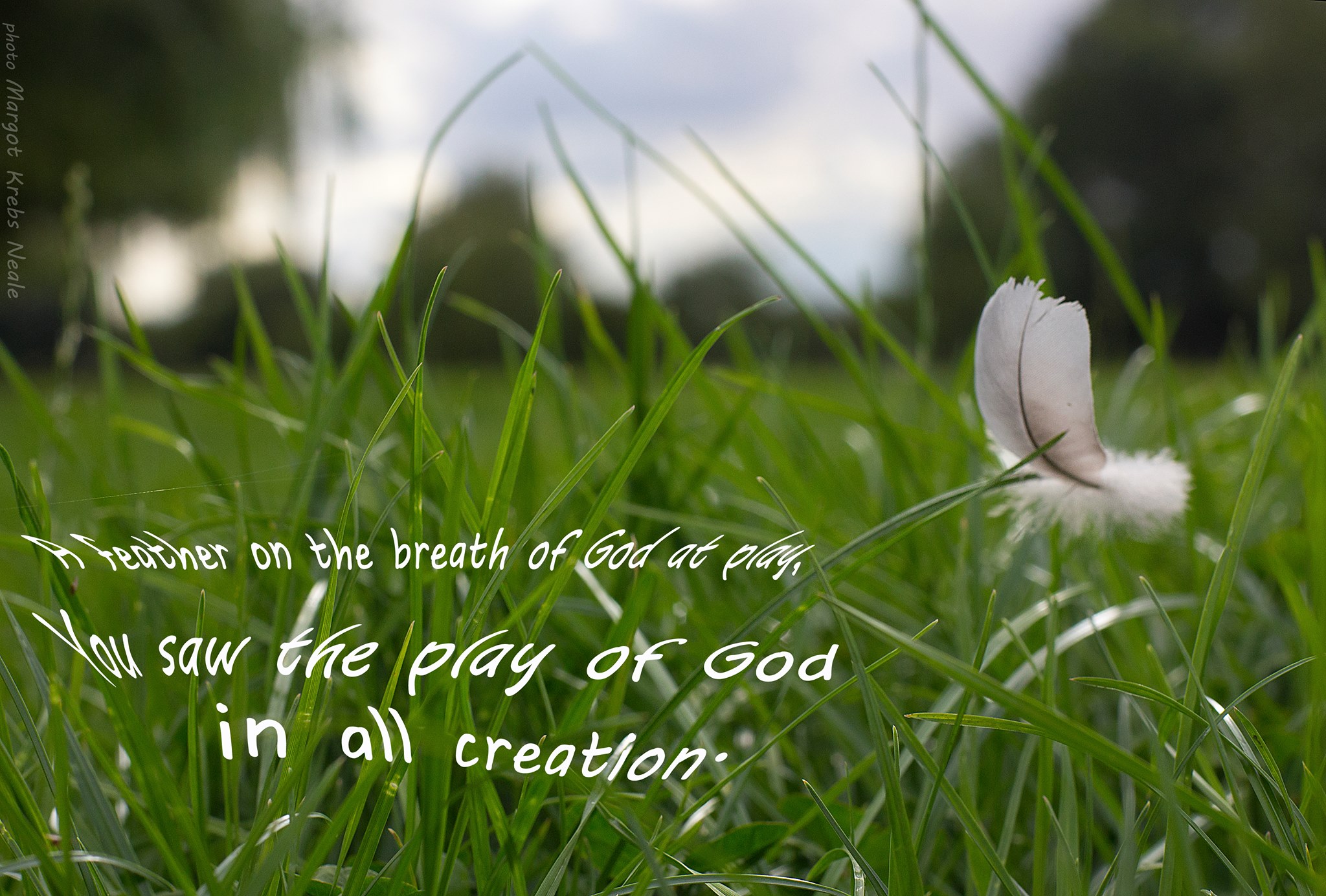
Photo by Margot Krebs Neale

Wednesday, 23 August 2017

Terror within and evil without : our capacity for transformation as individuals & nations

From The Editor, one of the most precious sites on the internet is Brain Pickings, masterminded by the wonderful Maria Popova.  There is so much in BP to feed the intellect and the spirit.

The Terror Within and the Evil Without: James Baldwin on Our Capacity for Transformation as Individuals and Nations

“The self,” the poet Robert Penn Warren observed in his immensely insightful meditation on the trouble with “finding yourself,” “is a style of being, continually expanding in a vital process of definition, affirmation, revision, and growth, a process that is the image, we may say, of the life process of a healthy society itself.” Indeed, if the great humanistic philosopher and psychologist Erich Fromm was correct, as I believe he was, in asserting that self-love is the foundation of a sane society, our responsibility to ourselves — and to our selves — is really a responsibility to one another: to know our interiority intimately and hold our darkest sides up to the light of awareness. But part of our human folly is that we do this far less readily than we shine the scorching beam of blameful attention on the darknesses of others.
That is what James Baldwin (August 2, 1924–December 1, 1987) explores in a magnificent 1964 piece titled “Nothing Personal,” found in The Price of the Ticket: Collected Nonfiction (public library) — the indispensable volume that gave us Baldwin on the creative process and his definition of love.
James Baldwin (Photograph: Sedat Pakay)
A year after he contemplated “the doom and glory of knowing who you are and what you are,” Baldwin writes:
It has always been much easier (because it has always seemed much safer) to give a name to the evil without than to locate the terror within. And yet, the terror within is far truer and far more powerful than any of our labels: the labels change, the terror is constant. And this terror has something to do with that irreducible gap between the self one invents — the self one takes oneself as being, which is, however, and by definition, a provisional self — and the undiscoverable self which always has the power to blow the provisional self to bits.
Echoing Bruce Lee’s assertion that “to become different from what we are, we must have some awareness of what we are,” Baldwin turns his critical yet uncynical intellect toward our capacity for self-transformation — the most difficult and rewarding of our inner resources comprising our collective potentiality:
It is perfectly possible — indeed, it is far from uncommon — to go to bed one night, or wake up one morning, or simply walk through a door one has known all one’s life, and discover, between inhaling and exhaling, that the self one has sewn together with such effort is all dirty rags, is unusable, is gone: and out of what raw material will one build a self again? The lives of men — and, therefore, of nations — to an extent literally unimaginable, depend on how vividly this question lives in the mind. It is a question which can paralyze the mind, of course; but if the question does not live in the mind, then one is simply condemned to eternal youth, which is a synonym for corruption.
Complement this particular portion of the wholly invigorating The Price of the Ticket with pioneering social scientist John Gardner on the art of self-renewaland Tibetan Buddhist nun Pema Chödrön on self-transformation through difficult times, then revisit Baldwin on freedom and how we imprison ourselvesthe artist’s strugglethe writer’s responsibility in a divided society, and his increasingly timely forgotten conversations with Chinua Achebe about the political power of art, with Margaret Mead about identity, race, and the experience of otherness, and with Nikki Giovanni about what it means to be truly empowered.