Associate Professor in Islamic Studies, Director of The Centre for Islamic Studies and Civilisation (CISAC) and Executive Member of Public and Contextual Theology (PACT), Charles Sturt University and is affiliated with Islamic Sciences and Research Academy of Australia (ISRA).
In August of 2011, more than 30,000 people cheered wildly as the then U.S. presidential candidate and Texas Governor Rick Perry – now secretary of energy in the Trump administration – came to the center stage at “The Response: A Call to Prayer for a Nation in Crisis” at Reliant Stadium in Houston. Perry quoted from the Bible and preached about the need for salvation that comes from Jesus. He concluded with a prayer for a country he believed to be overwhelmed by problems:
“We see discord at home. We see fear in the marketplace. We see anger in the halls of government.”
He then proceeded to ask God for forgiveness for forgetting “who made us, who protects us, and who blesses us.” In response, the crowd exploded into cheers and praise to God.
Worshippers pray with Texas Gov. Rick Perry, seen at center and on screen, at The Response, a daylong prayer and fast rally, Aug. 6, 2011, at Reliant Stadium in Houston.AP Photo/Pat Sullivan
Five years later, on April 9, 2016, and 1,500 miles away at the Los Angeles Memorial Coliseum, tens of thousands of people gathered to pray for the supernatural transformation of America. The event consisted of more than 16 hours of healing sessions, worship music and prophecy from some of the most popular Charismatic Christian leaders in the world.
While not directly affiliated, these two events and the leaders who organized them are central players in a movement that we call “Independent Network Charismatic,” or INC, Christianity in our recently released book, “The Rise of Network Christianity.”
Based on our research, we believe that INC Christianity is significantly changing the religious landscape in America – and its politics.
Here is what we found about INC
INC Christianity is led by a network of popular independent religious entrepreneurs, often referred to as “apostles.” They have close ties, we found, to conservative U.S. politicians, including Sarah Palin, Newt Gingrich, Bobby Jindal, Rick Perry and more recently President Donald Trump.
Charismatic Christians emphasize supernatural miracles and divine interventions, but INC Christianity is different from other charismatics – and other Christian denominations in general – in the following ways:
It is not focused primarily on building congregations but rather on spreading beliefs and practices through media, conferences and ministry schools.
It is not so much about proselytizing to unbelievers as it is about transforming society through placing Christian believers in powerful positions in all sectors of society.
It is organized as a network of independent leaders rather than as formally organized denominations.
INC Christianity is the fastest-growing Christian group in America and possibly around the world. Over the 40 years from 1970 to 2010, the number of regular attenders of Protestant churches as a whole shrunk by an average of .05 percent per year, while independent neo-charismatic congregations (a category in which INC groups reside) grew by an average of 3.24 percent per year.
Its impact, however, is much greater than can be measured in church attendance. This is because INC Christianity is not centrally concerned with building congregations, but spreading beliefs and practices.
Bill Johnson, pastor of Bethel Church in Redding, California.Kevin Shorter, CC BY
The influence of INC Christianity can be seen in the millions of hits on manyof theirweb-basedmediasites, large turnouts at stadium rallies and conferences, and millions of dollars in media sales. In our interviews with leaders, we found that Bethel, an INC ministry based in Redding, California, for example, in 2013 had an income of US$8.4 million in media sales (music, books, DVDs, web-based content) and $7 million in tuition to their Bethel School of Supernatural Ministry.
According to the director of media services at the Kansas City-based International House of Prayer (IHOP), their website receives over 25 million hits every year from all over the world and is one of the top 50 websites in the world in terms of viewed video content (a million hours of watched video content per month).
Appeal of INC
As part of our research we conducted in-depth interviews with senior leaders, staff and current and former participants in INC Christian ministries. We also conducted supplementary interviews with Christian leaders and scholars with knowledge of the changing religious landscape and attended conferences, numerous church services, ministry school sessions, healing sessions and exorcisms. In all, we conducted 41 in-depth interviews.
Our primary conclusion is that the growth of these groups is largely the result of their network governance structure. When compared to the oversight and accountability of formal congregations and denominations, these structures allow for more experimentation. This includes “extreme” experiences of the supernatural, unorthodox beliefs and practices, and financing as well as marketing techniques that leverage the power of the internet.
In our research, we witnessed the appeal of INC Christianity, particularly among young people. We saw the thrill of holding impromptu supernatural healing sessions in the emergency room of a large public hospital, the intrigue of ministry school class sessions devoted to the techniques of casting out demonic spirits and the adventure of teams of young people going out into public places, seeking direct guidance from God as to whom to heal or to relay specific divine messages.
‘Seven mountains of culture’
In addition to the growth numbers, the importance of INC Christianity lies in the fact that its proponents have a fundamentally different view of the relationship between the Christian faith and society than most Christian groups throughout American history.
Most Christian groups in America have seen the role of the church as connecting individuals to God through the saving grace of Jesus and building congregations that provide communities of meaning and belonging through worship services. They also believe in serving and providing for the needs their local communities. Such traditional Christian groups believe that although the world can be improved, it will not be restored to God’s original plan (until Jesus comes back again to rule the Earth).
INC beliefs, however, are different – their leaders are not content simply to connect individuals to God and grow congregations. Most INC Christian groups we studied seek to bring heaven or God’s intended perfect society to Earth by placing “kingdom-minded people” in powerful positions at the top of all sectors of society.
INC leaders have labeled them the “seven mountains of culture.” These include business, government, media, arts and entertainment, education, family and religion. In this form of “trickle-down Christianity,” they believe if Christians rise to the top of all seven “mountains,” society will be completely transformed.
One INC leader we interviewed summed it up this way:
“The goal of this new movement is transforming social units like cities, ethnic groups, nations rather than individuals…if Christians permeate each mountain and rise to the top of all seven mountains…society would have biblical morality, people would live in harmony, there would be peace and not war, there would be no poverty.”
We heard these ideas repeatedly in most of our interviews, at events we attended and in INC media materials.
Most significantly, since the 2016 presidential election, some INC leaders have released public statements claiming that the Trump presidency is part of fulfilling God’s plan to “bring heaven to Earth” by placing believers in top posts, including Rick Perry, who is currently heading the Energy Department; Betsy DeVos directing the Department of Education; and Ben Carson leading the Department of Housing and Urban Development.
Changing the landscape
INC Christianity is a movement to watch because we think it will continue to draw adherents in large numbers in the future. It will produce a growing number of Christians who see their goal not just as saving souls but as transforming society by taking control over its institutions.
We see the likelihood of INC Christians taking over the “seven mountains of culture” as slim. However, we also believe that this movement is sure to shake up the religious and political landscape for generations to come.
On July the 11th the Church celebrates the feast of St. Benedict of Nursia, the gentle founder of the Benedictine order and by extension the father of Monasticism. A moderate and modest man he would have been astonished to learn that his ‘simple school for prayer’, his ‘modest rule for beginners’ led to the foundation of communities which kept the Christian flame alight through dark ages, preserved not only Christian faith, scripture, and culture,but also the best of Classical Pagan learning and culture, fed the poor, transformed societies, promoted learning and scholarship, and today provides solace, grounding, perspective and retreat not only to monks and nuns but to millions of lay people around the world. Here is my sonnet for Benedict, drawing largely on phrases from the Rule, I dedicate it to the sisters at Turvey Abbey. It appears in my second book with Canterbury Press, The Singing Bowl
As always you can hear the sonnet by clicking on the ‘play’ button or the title.
You sought to start a simple school of prayer, A modest, gentle, moderate attempt, With nothing made too harsh or hard to bear, No treating or retreating with contempt, A little rule, a small obedience That sets aside, and tills the chosen ground, Fruitful humility, chosen innocence, A binding by which freedom might be found
You call us all to live, and see good days, Centre in Christ and enter in his peace, To seek his Way amidst our many ways, Find blessedness in blessing, peace in praise, To clear and keep for Love a sacred space That we might be beginners in God’s grace.
Beside The Creek is starting a list and is seeking contributions to extending the list. Readers will get the gist of the list so far as it is set out below. The list concerns faith attitudes to money, wealth, and possessions. If you have additions to the list please forward them to
misseaglesnetwork@gmail.com.
The blog editor will decide on inclusion in the list based on relevance. Beside The Creek admits a bias to faith communities who have a spiritual, community, and altruistic attitude to wealth. The editor is not keen on the amassing of wealth as a spiritual value - so if this is a significant part of the submission, the editor will need to be convinced of the value of such a principle to include it in the list. Here is the list to date:
The author of this blog has, as her oldest internet friend - even before blogs, Steve Hayes who lives in South Africa. Steve's blog is Khanya. The post below was published on his blog on 7 July 2017. It is republished here with Steve's permission for which I am grateful. For some people, this might be an unusual or distasteful topic. However, without serious consideration and knowledge of this topic, we will be hindered in understanding a large slice of humanity. In fact, when the author of this blog was doing her degree in religious studies, we started off with the James Frazer's The Golden Bough. The Ballarat Library holds the complete set of The Golden Bough - and it is not tucked away in storage but right there on the shelves. ~~~~~~
Witchcraft in literature and life (coffee klatsch)
At our literary coffee klatsch this morning we discussed witchcraft in literature and life, but we didn’t nearly exhaust the subject, so we decided to to continue the discussion next time.
The reason for discussing it was that Duncan Reyburn had published a contribution in a book on witchcraft and demonology, but the book cost far more than most of us could afford, so we asked him to tell us a bit about it and his approach to the subject. I was also struck by the difference between his bibliography and mine in an article on witchcraft 20 years earlier. I dealt with all this in an earlier article, so I won’t repeat it here.
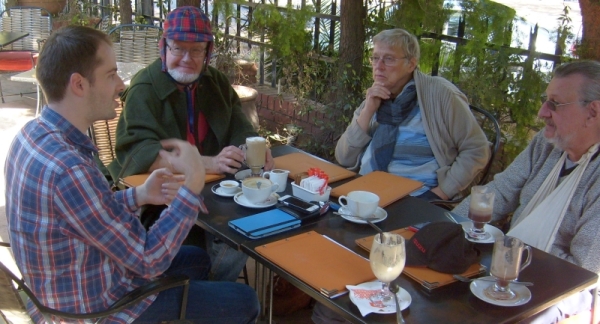
NeoInklings Literary Coffee Klatsch: Duncan Reyburn, David Levey, Janneke Weidema, Tony McGregor.
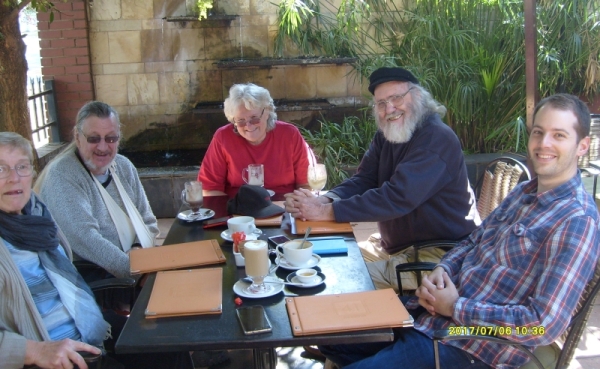
Cafe 41, Arcadia, Tshwane
Duncan’s contribution to the books was about how King James was a being really nasty when he wrote his book Daemonologie in 1597. He interprets it in the light the work of René Girard (1923-2015) and especially Girard’s concept of mimetic desire.
If people imitate each other’s desires, they may wind up desiring the very same things; and if they desire the same things, they may easily become rivals, as they reach for the same objects. Girard usually distinguishes ‘imitation’ from ‘mimesis’. The former is usually understood as the positive aspect of reproducing someone else’s behavior, whereas the latter usually implies the negative aspect of rivalry. It should also be mentioned that because the former usually is understood to refer to mimicry, Girard proposes the latter term to refer to the deeper, instinctive response that humans have to each other.
Duncan said that just as King James believed that witches wanted him dead, so he wanted them dead, and vice versa. King James recommended the persecution of witches because he believed that witches were conspiring against him. King James also did not have any clear conception of demons. He believed that witches were inspired by Satan, and there was no hierarchy (or “lowerarchy”, as C.S. Lewis calls it) of evil. There was just Satan and the witches, with no demons in between.
Janneke said that this recalled the Calvinism of her youth, which flattened the hierarchy of the church, so that there were just elders and people. She said this was correlated with literacy — as more people learned to read, they became less reliant on a clerical class.
I recalled reading a book by John Buchan (an imperialist and member of Milner’s Kindergarten) called Witch Wood. I read it a long time ago, and have not seen a copy since, but as I recall it, the good Calvinists went to church by day and practised witchcraft by night, but saw no conflict, because they were among the elect, predestined to be saved, so nothing they did could affect that. I suspect that Buchan’s understanding of the matter was about as accurate as his picture of African Independent Churches in another novel, Prester John, which was, however, probably accurate in the picture it gives of the views of such churches by British civil servants in the conquered Transvaal Colony.
Janneke Weidema, Tony McGregor, Val Hayes, Steve Hayes, Duncan Reyburn — literary coffee klatsch, 6 July 2017
King James wrote his Daemonologie in 1597, at the height of the Great European Witchhunt. People whose minds are saturated with modernity like to refer to those witchhunts as “medieval”, but they were not, they were modern, and arose in the Early Modern period. It is interesting that in the current period, when much of Africa is in transition from premodernity to modernity, there has also been an increase in witchhunting.
Charles Williams, one of the original Inklings, wrote Witchcraft, a history of Christian responses to witchcraft, and noted how the attitude to witchcraft completely changed in the early modern period. Previously it was considered heretical for Christians to believe that witches could harm people, because it showed a lack of faith in Christ, who had conquered evil. In Early Modern Europe, however, it became heretical not to believe that witches could harm people. Earlier, people who made false accusations of witchcraft could be punished, but in Early Modern Europe failure to accuse could be interpreted as a sign of being a witch. Witchcraft came to be seen as a huge satanic conspiracy against church and state. As Charles Williams puts it:
The Salic law of Charlemagne decreed that anyone who was convicted of witch-cannibalism should be heavily fined, but also that anyone who was found guilty of bringing such an accusation falsely should be fined an amount equal to one third of the other… The secular governments of centuries earlier had been wiser; they had penalized the talk as much as the act. The new effort did not do so; it encouraged the talk against the act.
Christianity came into a world in which witchcraft was already known and feared as evil. For many pagans, the only proper penalty for witchcraft was death. Again, as Charles Williams put it:
Before Christendom began, magic, with its lower accompaniment of witchcraft, preoccupied the whole Roman Empire; we have forgotten the darkness out of which we came. It was as popular as it was perilous. It was certainly regarded by the authorities as a public danger, but, on the whole, action against it was taken only by private persons in lawsuits or by the government in suspicion of treason.
In much of premodern Africa, witches were regarded as incorrigible, and the only way of nullifying their power was to kill them. Nearly all evil, sickness, accidents and other misfortunes, were regarded as being caused by human malice — witchcraft. There were spiritual or religious specialists who could smell out who was responsible for a particular misfortune, and the English translated most of the words for these specialists as “witchdoctors” — doctors who could remedy the evils caused by witchcraft.
Christian missionaries from late modern Europe and North America could not cope with premodern notions of witchcraft, and so saw their mission as modernising Africans (they called it “civilising”) to show them that such notions were false and out of date. It was African independent church groups like the Zionists who recontextualised the Christian gospel back into premodern terms to show how it could deal with African problems rather than modern European ones.
We briefly discussed the way in which, in English usage, “witch” has come to be seen as mostly female, while the male equivalent are called “wizards”, as in the Harry Potter stories. Perhaps we can talk about that more next month. Some did a bit of Googling on cell phones, but I think the following is more helpful:
What really is a witch? One answer lies in the roots and development of words. ‘Witch’ derives from the Old English wicca (pronounced ‘witcha’ and meaning male witch) and wicce (‘female witch’, pronounced ‘witcheh’) and from the word wiccian, meaning ‘to cast a spell’. Contrary to common belief among modern witches, it is not Celtic in derivation, and it has nothing to do with the Old English witan, ‘to know’, or any other word relating to wisdom. The explanation that witchcraft means ‘craft of the wise’ is false…
‘Wizard’, unlike ‘witch’, really does derive from Middle English wis, ‘wise’. The word first appears about 1440, meaning a ‘wise man or woman’; in the sixteenth and seventeenth centuries it designated a high magician, and only after 1825 was it used as the equivalent of ‘witch’ (Russell 1980:12).
For others who were there, if you think I missed something important, or got something wrong, please clarify in the comments section.
Jews, Christians & Muslims seeking interaction and dialogue with one another in a safe environment are invited to attend the JCMA Winter Conference on the theme "Faith and Society".
Date: Sunday 2.00pm 6th August – 5.30pm 7th August
Venue: St Paul's Retreat Centre, Norton's Lane, Wantirna South
(a)to draw together members of the Abrahamic faiths in mutual respect, seeking to appreciate each other and to heal ancient wounds, pledging mutual support in times of stress and engaging in dialogue in all its aspects;
(b)to organise conferences and other activities for the purpose of learning about each other’s faith, of sharing personal experience, and of discussing issues of concern within their own faith communities and within the broader society.
The Annual JCMA Conference is modelled on the annual residential conference of Jews, Christians and Muslims in Europe and is supported by major religious institutions within each faith community.
The conference is held in a relaxing environment conducive to both personal reflection and warm, open meetings and discussions.
Who is it for?
• JCMA conferences are intended for people of all ages who are members of one of the three Abrahamic faith communities, Judaism, Christianity and Islam and is supported by major religious institutions within each faith community.
• Participants include men and women, young and old, lay and clergy, academics and students, and those working in community or welfare roles.
• All participants, speakers and discussion group leaders are asked to attend the full conference from 2pm on Sunday 6 August to 5:30 pm on Monday 7 August. For most participants this will include residential accommodation overnight.
• Anyone who subscribes to the aims and purpose of the conference are encouraged to register their interest, but registration of interest does not guarantee a place in the conference. Final place offers will be made by the Conference Committee.
Registration of Interest
1. If you would like to attend the 2017 JCMA Winter Conference, we ask that you apply by filling in a “registration of interest” online at https://jcmawinterconference2017.eventbrite.com.au/ before the closing date of Monday July 24.
2. The Conference Planning Committee will review each registration of interest before offering a place in the Conference to the selected applicants
3. When you are notified that your application to attend has been approved, you will receive an email directing you to an Eventbrite site where you can pay the Conference fee of $160.
4. Further details of the event and the program will then be provided by email.
You can call Ginette Everest 0n 03 9287 5590 for more information.
Ginette Everest
Executive Officer
Jewish Christian Muslim Association of Australia (JCMA)
JCMA relies on the goodwill of volunteers and the generosity of our donors.
Donations are tax deductible. Please go to JCMA Donation to make a donation.